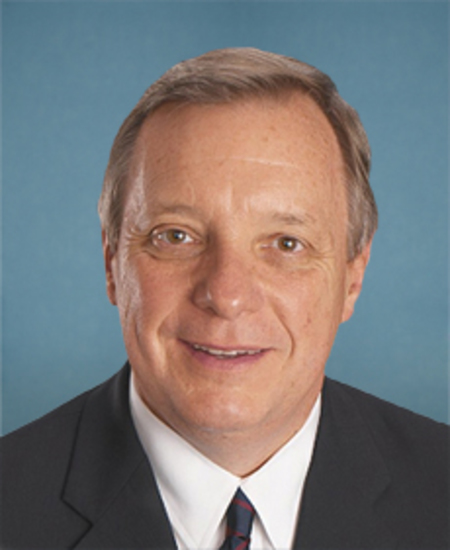
Durbin Urges Senate Colleagues To Support His Bipartisan Credit Card Competition Act
WASHINGTON – In a speech on the Senate floor today, U.S. Senate Democratic Whip Dick Durbin (D-IL) urged his Senate colleagues to support his bipartisan legislation with U.S. Senator Roger Marshall, M.D. (R-KS), theCredit Card Competition Act(CCCA), which would increase competition in the credit card market and put an end to the Visa-Mastercard duopoly that is squeezing small businesses—and, ultimately, consumers. Durbin and Marshall re-introduced the legislation earlier this week, which was endorsed by President Trump.
Today, Visa and Mastercard control about 85 percent of the credit card market and refuse to negotiate fair terms with Main Street merchants. Currently, the average American family pays nearly $1,200 per year in swipe fees, while banks profit $111.2 billion annually from swipe fees.
“Data released this week by the Bureau of Labor Statistics confirms what many in this chamber know… and what Americans feel every day: prices are just too high. Consumer prices—from rent to groceries to utilities and more—are up nearly three percent compared to last year. Affordability is real,”Durbin said.“And while costs continue to go up and everyday Americans are struggling, big banks are rolling in cash with profit margins around 30 percent.”
Durbin continued,“Why are big banks making so much money? It is because they profit off of something called a ‘swipe’ fee, an ‘interchange’ fee. Every time you use your credit card, Visa or Mastercard, they charge the merchant what is essentially a service fee. The merchant pays a fee of two to three percent on each transaction… While Visa and Mastercard keep some of the [fee] for themselves, most is pocketed by the big banks that issue the cards. A few bucks here and a few bucks there, and you’ve got a pretty good haul if you’re a big bank. How good? In 2024, Visa and Mastercard and their big bank partners raked in more than $111 billion in credit card swipe fees.”
Durbin went on to share stories of his constituents in Illinois whose small businesses are being crushed by these swipe fees.
“If you don’t believe me, listen to what a constituent of mine in Chicago wrote. Rick is his name. He owns a gas station. He pays $50,000 to $60,000 a year in swipe fees. He says, and I quote, ‘these fees have an impact on pricing in the store.’ Small business owners like Rick have little recourse. Visa and Mastercard have a near virtual grasp on the credit card market controlling about 85 percent of it,”Durbin said.
Durbin continued,“This individual, Laura, says she owns a coffee shop. ‘My per ticket amounts are low, roughly $5. Yet each transaction can take up to 25 cents in swipe fees to the credit cards. We need competition in the credit card marketplace and options to choose from. Just like small businesses have to compete for customers, credit card companies should have to compete for our business.’ Laura has a coffee and tea business in Elmhurst, Illinois. Why are big banks making so much money? The swipe fees are virtually unregulated. We’d like to change that. Another source of information from Susser, Illinois, which is in downstate southern Illinois, Greg Kelly writes me, ‘When combined with basic merchant processing fees and set monthly access fees, credit card fees can add up to nearly five percent of total transactions.’ Greg writes, ‘This is insane. This prevents hiring and hinders business growth as well as being able to compete. Credit card reform is needed now.’”
Opponents of the CCCA have falsely claimed that such provisions would squeeze Visa, Mastercard, and the big banks, and force them to scale-back reward programs. But in 2024, banks netted about $378 billion in revenue from debit and credit cards, but they only paid out $47 billion in rewards. And an analysis by payments consulting firm CMSPI found that rewards would be reduced by less than one-tenth of one percent “at most” because of theCredit Card Competition Act.
“The banking industry hates the Marshall-Durbin [Credit Card Competition Act] like the devil hates holy water. To them, any kind of regulation is unacceptable,”Durbin said.“By injecting competition in the credit card market, this bill would help bring down swipe fees that small businesses pay and that ultimately get passed on to America’s working families in the form of higher prices.”
Durbin concluded,“I urge my Senate colleagues: let’s come together and get this done on behalf of consumers and small businesses. You want to do something that really makes a difference for the bottom line [and] debt of families, address the outrageous interest rates being charged on credit cards and address the swipe fee that’s being charged on retailers… This is the time to do it. If we’re going to meaningfully address the real expenses that families face, I urge my colleagues to look at this bipartisan measure, commonsense measure that will make a difference for the families that we represent.”
Video of Durbin’s remarks on the Senate floor is availablehere.
Audio of Durbin’s remarks on the Senate floor is availablehere.
Footage of Durbin’s remarks on the Senate floor is availableherefor TV Stations.
Durbin and Marshall also introduced theCredit Card Competition Actlast Congress. The legislation was cosponsored by then-Senator JD Vance (R-OH), Peter Welch (D-VT), Jack Reed (D-RI), and Josh Hawley (R-MO). This legislation would increase competition in the credit card processing market by requiring large banks with more than $100 billion in assets to enable at least two unaffiliated card networks (including one outside Visa/Mastercard), helping lower swipe fees for small businesses and passing savings on to consumers.
Full text of the legislation can be foundhere.
-30-
013e226d-30df-4dca-9f92-27a3794665e5Issued within 24 hours
Other senators' releases published in the day before or after this one.