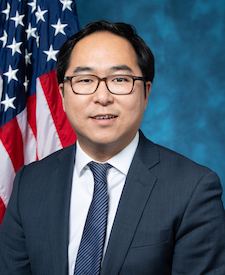
“The Resilience Principles” Senator Kim’s Guide for American Leadership in the Post-Trump Era
“If we are no longer the indispensable nation, and if we rightly reject being seen as the undependable nation, then we should strive to become the resilient nation” – Senator Andy Kim
PRINCETON, NJ– Today, Senator Andy Kim (D-NJ) delivered remarks at Princeton University as part of the School of Public and International Affairs’ 250th anniversary programming, laying out a vision for American foreign policy in an era of shifting global power.
Drawing on his background as a State Department officer and civilian advisor in Afghanistan, as well as his time in Congress, Senator Kim warned that America risks being left behind as allies lose confidence in U.S. leadership — and outlined seven principles for building a more resilient nation at home and abroad. His remarks came as President Trump deeply escalated his threats against Iran and its people this morning.
Clickhereto read the Senator’s full remarks, as prepared.
Senator Kim’s Seven Guiding Principles:
1.Economic security is national security:
“We should protect the economic security of American families with the same intensity as we do our nation’s physical security…Americans don’t just feel insecure when they look at global threats, they feel insecure when they look at their families and can’t assure them that things will be okay.”
2.Resource and energy security is national security:
“I call on Congress to take on this issue with the same urgent bipartisan focus and drive as we did for the Chips and Science act and the bipartisan infrastructure law, and provide a comprehensive framework for securing our supply chains, building refining and processing capabilities, and increasing our energy production…”
3.Resilience isn’t self-reliance:
“Concerns about our supply chains shows that [America] can’t do this all alone… resilience-focused diplomacy will also mean updating and adapting our alliances to be more flexible and durable, organized around not just our defense relationships or geography but around the economic and technological relationships that will power the future global economy.”
4.Resilience demands that we modernize our defense capabilities and posture as we build new infrastructure for diplomacy:
“…the global order is shifting around us – to one that is more multipolar, where autocrats are on the rise, where the pace of technological innovation will have unknown benefits and consequences…and where American global leadership is in question. This moment that our government has not been preparing for – and that the current administration is only making worse with its actions.”
“…we must break down the artificial barrier between foreign policy and domestic policy – [foreign policy] alone cannot deliver for the American people…we cannot operate in a space where only the President and a handful of top advisors occupy the Venn diagram overlap between domestic and foreign policy.”
5.Resilience requires pragmatism:
“What I heard [at Munich Security Conference] should worry us all because it was there where I saw the first real glimpses of a Post-America World. One European partner said, ‘“We can’t wait for you anymore.”’In the eyes of the world, we are no longer the indispensable nation, we have instead become the undependable nation.”
“…we need to commit ourselves to employing our military only in vitally important circumstances core to our national interests. The current misguided war in Iran only underscores the unintended and costly consequences of pursuing a war of choice – not only in the short-term, but potentially major strategic consequences in the long term that will harm our ability to maintain deterrence in the Indo-Pacific.”
6.Restoring Americans’ faith in government and rooting out corruption is paramount – [America] cannot lead globally if foundations are not strong at home:
“Americans across the country and the political spectrum are saying that the current state of the world isn’t working for them. That they do not want us to continue the interventionist foreign policy of the past, but want their leaders to ensure security, stability, and access to the quality of life they deserve.”
7.Resilience isn’t an end in itself –it is an enabling state to build something even greater:
“Right now, people from around the world who aspire to achieve the American Dream are being told you’re not welcome – and the message is being received… as we move beyond Trump…it requires us to build a strategy to make sure we are on the cutting edge of the technologies to defend opportunity, working with allies and partners, and understand that production, not just destruction, will be key to keeping our future safe.”
After his remarks, Senator Kim took part in a student Q&A where he answered questions about the importance of USAID and the disastrous consequences that have occurred around the world because of the funding cuts made by the Trump Administration, the need to make healthcare more affordable, especially when it comes to students and young people, innovation and investments needed for technologies like renewable energy that will make America more self-sufficient, how Democrats must engage young people so they are invested in the future, and how to manage and balance domestic and foreign policy at home.
###
Hart Senate Office BuildingSuite 520Washington, D.C. 20510
Phone: (202) 224-4744
210 Hudson StreetHarborside 3, Suite 1000Jersey City, NJ 07311
Phone: (201) 377-0900
208 White Horse PikeSuite 18Barrington, NJ 08007
Phone: (856) 757-5353
0442e534-607e-4261-a90c-3cf07b3c9822Issued within 24 hours
Other senators' releases published in the day before or after this one.