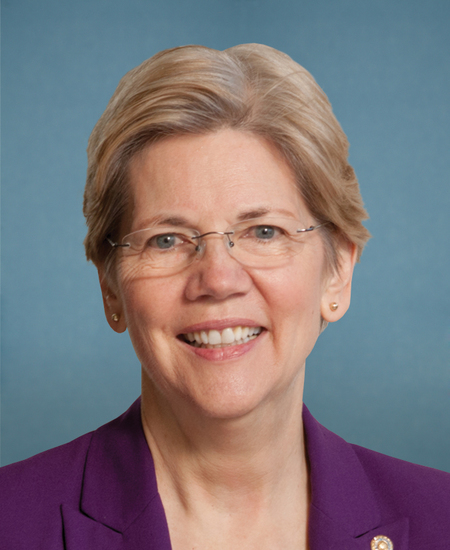
Warren, Lawmakers Open Investigation Into Republicans’ Massive Trump Tax Subsidies for Big Tech’s AI Spending
Despite rising corporate profits, corporate tax receipts are down 25% this year, with AI tax subsidies driving much of the drop “Your company has spent lavishly to stay on the good side of President Trump, and it appears that you are now seeing your investment bear fruit” Text of Amazon Letter (PDF) | Text of Meta Letter (PDF) | Text of Alphabet Letter (PDF) | Text of Microsoft Letter (PDF) Washington, D.C. — U.S. Senator Elizabeth Warren (D-Mass.) led lawmakers in writing to the CEOs of Amazon, Meta, Alphabet, and Microsoft, pushing for transparency on the extent to which each company’s investments in AI — including their massive spending on data centers — have been subsidized by tax breaks handed out by President Trump and Republicans in Congress. Senators Elissa Slotkin (D-Mich.), Jeff Merkley (D-Ore.), Bernie Sanders (I-Vt.), Richard Blumenthal (D-Conn.), and Tina Smith (D-Minn.) joined the letters as well. “Americans across the country are worried about the impacts of artificial intelligence (AI) on their lives — from increased utility bills to threats of job losses and cyberattacks,” wrote the senators . “Rather than regulate AI to protect American families or address the nation’s affordability crisis, the Trump administration and its Republican allies in Congress have prioritized handing out colossal tax breaks to giant corporations . ” President Trump and Republicans’ One, Big, Beautiful Bill Act (OBBBA), which passed in 2025, contained provisions that have allowed Big Tech companies to slash their tax bills by deducting billions of dollars of spending on AI development. New data reveals that these tax handouts have substantially contributed to a 25 percent drop in corporate tax revenue this year, even amid rising revenues and profits for Big Tech. Microsoft’s current federal tax expense, for example, dropped by over $11 billion between FY 2025 and FY 2026, while the company’s pre-tax income increased $42.3 billion. Similarly, Meta’s current federal tax expense decreased by nearly $7 billion between 2024 and 2025, while the company’s pre-tax income increased by over $15 billion. “This enormous tax cut appears to have been driven in significant part by President Trump and Republicans’ tax breaks subsidizing your spending on AI,” wrote the lawmakers . The same Big Tech companies have been spending millions of dollars lobbying Republicans and the Trump administration. Each of the four corporations donated $1 million to the President’s inauguration and spent millions more lobbying Congress and federal agencies leading up to the passage of OBBBA. “Your company has spent lavishly to stay on the good side of President Trump, and it appears that you are now seeing your investment bear fruit,” wrote the senators to the Big Tech companies. The senators demanded these massive companies provide transparency on the nature of the tax breaks they received and disclose any lobbying they had done to receive them by October 11, 2026. “These tax breaks are not free—their cost has been imposed on American families via cuts to critical social services and a higher deficit,” wrote the senators . Senator Warren has sounded the alarm on how provisions from the Big, Beautiful Bill are a massive giveaway to the ultra-rich: In July 2026, Senator Warren (D-Mass.) wrote to the nonpartisan Joint Committee on Taxation (JCT), seeking information about the One Big Beautiful Bill Act (OBBBA)’s expansion of the Qualified Small Business Stock (QSBS) exclusion, which is projected to cost taxpayers $17.2 billion. The request comes roughly one year after Donald Trump and Republicans in Congress fast-tracked the bill’s passage. In September 2025, Senator Warren (D-Mass.) wrote to the nonpartisan Congressional Joint Committee on Taxation (JCT), seeking information about the Big, Beautiful Bill’s permanent extension of 100% bonus depreciation , which previous research has shown is a giveaway to massive corporations. The tax break is a major windfall for giant corporations by allowing them to write off the cost of new materials or investments immediately, instead of over the lifetime of those assets. JCT estimates that the permanent extension of this provision will cost a whopping $362.7 billion over ten years. In August 2025, Senator Warren (D-Mass.) published a new analysis from the nonpartisan Joint Committee on Taxation (JCT) revealing that President Trump’s “Big, Beautiful Bill” will deliver $67 billion in retroactive tax breaks to corporations in 2026. The JCT analysis comes in response to a June 2025 request from Senator Warren for information on Republicans’ legislation to effectively expand the size of tax breaks that corporations will receive for research they have already conducted. In June 2025, Senator Warren (D-Mass.) wrote to the Joint Committee on Taxation (JCT), a nonpartisan Congressional committee dedicated to analyzing tax legislation, asking the committee to provide information on the revenue impact of giving billionaire corporations retroactive tax breaks. In March 2025, in a new response to a letter sent by Senators Warren (D-Mass.), Cortez Masto (D-Nev.), Warner (D-Va.), Bennet (D-Colo.), and Welch (D-Vt.), the nonpartisan Joint Committee on Taxation (JCT) revealed the unprecedented nature of Republicans’ proposed “magic math” to pay for billionaire tax cuts and falsely claim no cost to American taxpayers. In February 2025, Senators Warren (D-Mass.), Cortez Masto (D-Nev.), Warner (D-Va.), Bennet (D-Colo.), and Welch (D-Vt.) wrote to the nonpartisan Joint Committee on Taxation (JCT), pressing for answers on the scoring methods used for tax legislation ahead of the expiration of many of the tax provisions contained in President Trump’s 2017 Tax Cuts and Jobs Act (TCJA). ###
15eb1ca4-de28-4d22-915d-9c905e064773Issued within 24 hours
Other senators' releases published in the day before or after this one.