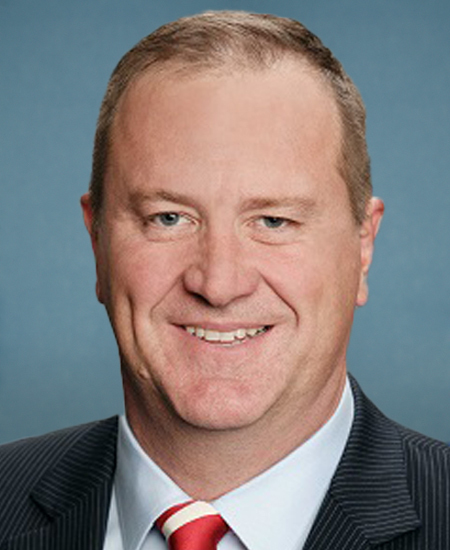
Schmitt Introduces Modern Skies Act to Invest in America’s Airports, Support Air Traffic Control
Legislation Would Invest $30 Billion in Air Traffic Control, Airport Towers, Terminals, and Infrastructure to Improve Reliability for Americans U.S. SENATE — Today, U.S. Senator Eric Schmitt (R-MO) introduced the “Modern Skies Act” to update America’s aviation infrastructure by investing $30 billion in air traffic control, airport towers, airport terminals, and other critical airport infrastructure. Senator Schmitt joined Department of Transportation Secretary Sean Duffy in a press conference today to announce the bill. “Air travel is more accessible than ever, but for too many Americans, getting where they need to go still feels like a gamble. Travelers face long lines, aging airports, constant delays, and an air traffic control system in desperate need of attention. That is a far cry from the golden age of American aviation that St. Louis’ own Charles Lindbergh helped usher in. The Modern Skies Act will launch a new era of American aviation by building a world-class system that works better for air traffic controllers, airlines, and, most importantly, passengers,” said Senator Schmitt. “President Trump and Secretary Duffy are tackling these challenges head-on, and I’m proud to lead this effort alongside them to make air travel great again.” “Under President Trump, we have made historic progress revitalizing our airspace. With investments from the Working Families Tax Cut, we’ve already replaced the majority of outdated copper wire with high-speed fiber in our towers, transitioned nearly a third of radios controllers used, and installed new surveillance technology in half of our target airports. We’ve also reimagining how we manage the airspace – deploying a state-of-the-art scheduling tool to prevent delays and cancellations,” said U.S. Transportation Secretary Sean Duffy. “But to finally fix air travel for the American people, we need to pass the Modern Skies Act. This bill will give us the funding we need to modernize the digital architecture powering air traffic control, replace crumbling aviation infrastructure, and build world-class airports across the country. I’m grateful for Senator Schmitt’s partnership to help us finish the job and deliver real change for the flying public.” Background: Schmitt’s legislation builds on the $12.5 billion Congress provided through the Working Families Tax Cuts for a new Air Traffic Control system to upgrade telecommunications, radar, facilities, controller training, and runway safety. The legislation provides an additional $10 billion for Phase 2 of the modernization effort. This investment would move beyond replacing aging infrastructure and begin delivering the technology needed for more integrated management of aircraft, routes, trajectories, and airspace. For passengers, the goal is to help the FAA move flights through the country more reliably and recover more effectively when weather, congestion, or equipment problems occur. The legislation would also invest in airports and airport infrastructure, building on President Trump’s success at Dulles and continuing momentum toward restoring America’s airports to the world-class standard the American people deserve. The “Modern Skies Act” would provide: $10 billion for an Aging Terminal Pilot Program: Modernize or rebuild major terminals at up to three medium hub airports. The pilot program would demonstrate how substantial federal investment can improve aging terminals, expand passenger capacity, preserve distinctive architecture, support airline competition, strengthen service to smaller communities, and develop design approaches that could be used by other airports. $10.1 billion for Air Traffic Control Modernization: Fund the next phase of FAA air traffic control modernization, building on the $12.5 billion investment in the One Big Beautiful Bill. The funding would support consolidation of air traffic control facilities, a common automation platform and controller workstation, cloud and telecommunications infrastructure, and modern air traffic flow-management technology. These investments would help integrate the National Airspace System, improve congestion and disruption management, and support future aviation growth. Flexibility for Existing ATC Funding: Allow the FAA to transfer previously appropriated funding among components of the Brand-New Air Traffic Control System as implementation progresses, while maintaining congressional reporting requirements. $10 billion for Terminal, Tower, and Airport Improvements: Provide $2 billion to construct and modernize air traffic control towers and facilities, including digital tower technology; $3 billion for discretionary Airport Improvement Program projects; and $5 billion for airport terminal modernization. The funding would support airports of different sizes and continue the success of the Airport Terminal Program. Modernize the Full Aviation System: Together, the investments would upgrade the technology used to manage aircraft, the towers and facilities controllers rely on, and the airport infrastructure passengers and airlines depend on improving how aircraft move through the airspace while modernizing the airports where trips begin and end. FAA expects commercial flights to increase by more than 40 percent by 2046, alongside continued growth in drones, commercial space launches, and new types of aircraft. Statements of Support: “U.S. airlines staunchly support President Trump and Secretary Duffy’s continued efforts to modernize our nation’s air traffic control (ATC) system. In the past year, DOT has proven their ability to use taxpayer dollars wisely, tackling numerous navigation and telecom projects at record speed. This progress demonstrates what is possible when our leaders prioritize sustained investment in the National Airspace System (NAS), but the work is not done,” said Airlines for America President and CEO Chris Sununu . “We urge Congress to provide the additional $30 billion needed to sustain this momentum and deliver a modern ATC system equipped to meet the demand of today and tomorrow. This effort is essential to bolstering safety and efficiency, supporting the needs of the traveling and shipping public and maintaining the United States’ position as the world’s aviation leader.” “Modernizing our air traffic control system was long overdue, and pilots are already seeing some of the benefits from the work that started last year. Fiber is being installed, digital radios are coming online, and dozens of airports now have better tools to keep aircraft moving safely on the ground. But the first round of funding was never going to solve every problem. Many vulnerabilities still exist that can disrupt some of the busiest airspace in the country. Addressing those will require the additional funding that is being requested. ALPA supports this request, and we appreciate Secretary Duffy’s leadership and continued commitment to ensuring that the funding is put to good use,” said Air Line Pilots Association President Capt. Jason Ambrosi. “Department of Transportation Secretary Sean Duffy and the FAA are attempting to make meaningful progress in modernizing our nation’s air traffic control system, and NATCA supports Sen. Schmidt’s efforts to secure an additional $30 billion from Congress to continue that work. This investment will build on the $12.5 billion Congress provided last year, accelerate the replacement of aging infrastructure, deploy modern technology, and give the professionals who operate the National Airspace System the tools they need to keep our skies safe and efficient,” said NATCA President Nick Daniels . “Modernizing our aviation system requires investment in both cutting-edge technology and the infrastructure that supports it. AAAE applauds the Administration’s proposal for an additional $30 billion, including $10 billion for ATC towers and $10 billion for airport modernization, to enhance safety, efficiency, and reliability across the National Airspace System,” said American Association of Airport Executives President & CEO Todd Hauptli . “Aviation manufacturers continue to invest, innovate and provide solutions that improve safety. As aircraft technologies advance, so must the equipment and facilities that keep the skies safe, secure and resilient. We applaud the Administration’s proposal for new investments in the air traffic control system and airport infrastructure. It is imperative that Congress work expeditiously to approve this critical initiative to modernize and strengthen the aviation system and facilitate aviation safety and efficiency,” said GAMA President & CEO James Viola. ###
190b53ce-c115-4e5e-b76d-94758ea19f0fIssued within 24 hours
Other senators' releases published in the day before or after this one.