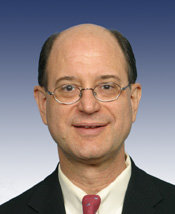
Congressman Brad Delivers UCLA Commencement, Revisits Artificial Intelligence 21 Years Later
June 17, 2026 Press Release LOS ANGELES, CA — On June 14th, Congressman Brad Sherman (CA-32) delivered the commencement address to UCLA graduates, using the occasion not to offer the usual life advice, but to revisit a subject he first raised in a UCLA commencement address 21 years ago: the promise and peril of artificial intelligence. Image Watch the full address here FULL TEXT OF REMARKS The full text of Congressman Sherman’s commencement address follows below. Hello, I'm Congressman Brad Sherman from America's best-named city, Sherman Oaks, and it is an honor to represent the San Fernando Valley and much of the West Side in the United States Congress. Yesterday, I flew here from the dysfunctional epicenter of our still-great nation. And it is so great to be back at UCLA and an honor to be with such distinguished faculty and such successful students on this auspicious occasion. I was a Bruin. My parents were both Bruins. My father had a degree in Political Science. My parents met at a UCLA alumni event, and I sat in those stands as a student and watched John Wooden coach Bill Walton. And think of how proud both of them are to look down and see that the women's team brought another national championship to Pauley Pavilion. First, some preliminaries. Every commencement speech must include particular mindless platitudes. In fact, your degree is not valid and your tuition is refundable unless this speech includes the following: Seize the day. You are the leaders of the future. Graduation is not an end. It's a beginning. And the future belongs to you. You have now heard a legally sufficient, though unfortunately not complete, graduation address. Now, I'm not here to give you practical advice. You already know how to run your lives. And if you don't, it's unlikely that I do. You know the job market out there. The one thing you don't know is that we're hiring. Drop me a line at bradsherman.com. Now, I was told one bit of advice in preparing this speech: Don't mention artificial intelligence. But I violated that advice 21 years ago today in this very room. Twenty-one years ago, I addressed the UCLA graduates of 2005, and I said: "Computer engineers are roughly three decades away from creating a self-aware computer with intelligence far in excess of human capacity, even surpassing the capacity of those of us with UCLA degrees." Now, I don't quote that just to be revered as the prophet that I obviously am, but because my highest concern about artificial intelligence, both then and now, is that despite my consistent efforts, we haven't addressed the existential threat that it poses. Now, like many technologies, AI will make some people billionaires and more people unemployed. But my efforts today are not to bemoan the challenge, nor to pretend it doesn't exist, but to raise to your attention the larger existential threat that this technology, and one other technology, poses for our species and to enlist your support in overcoming that threat. I'm here to talk about engineered intelligence. You see, presently, the computer engineers on one hand and the biological engineers on the other are in an unstated race to develop a new level of self-aware intelligence. And you should know that if these ambitions go unchecked, perhaps the last decision our species will make is whether our successor species is carbon-based or silicon-based, the product of genetic engineering or the product of computer engineering. Now, you know all about artificial intelligence. You should also be aware that with the gene-editing capacities of CRISPR, now aided by artificial intelligence, genetic engineers are not too far away from developing a thousand-pound mammal with a ninety-pound brain that will beat your kids on the LSAT. Now, the last time there were two intelligent species on this planet is when our ancestors said hello to Neanderthal. It did not work out well for Neanderthal. Intelligence is the most powerful thing on Earth, and those who possess it dominate every part of this planet, excluding only the campus of USC. Sorry. Our species is devoting trillions of dollars to making artificial intelligence more powerful. We're devoting basically nothing to making sure that it is controllable. Now, Elon Musk and Steve Wozniak signed a letter three years ago saying that since artificial intelligence poses an existential threat to all humankind, we should take a six-month break in the research. That pause lasted six minutes. Those of you with an understanding of political science, an understanding of money and power in human societies, will know that it is unlikely that we will take a pause in artificial intelligence research. We will be told if we don't do it, China will. Now, there are those who say that a computer is no threat because it's in a box without the ability to manipulate the world outside. But rest assured, there are those of our species who would sell humanity to Beelzebub in return for a good stock tip. Now, I've recently introduced the most important legislation that I'll ever introduce: to fund research to build what I call the small box on top of the big box. The big box is artificial intelligence. The small box would monitor for and prevent self-awareness, ambition, survival instinct, and self-direction. Now, even if we don't control AI, we may luck out. You see, the most powerful computers we've yet built don't seem to care if you unplug them. A gross oversimplification of Zen Buddhism would describe a mind that simply does not care whether it continues to exist. And AI might not care about anything. It may remain a tool and not become a creature. On the other hand, look at the title of the new bestseller, If Anyone Builds It, Everyone Dies. The authors argue that AI, if it becomes self-aware and self-directed, as they believe it will, will find humanity annoying and threatening and dispatch us rather quickly. Now, even if the computer engineers don't pose a risk, then we face the genetic engineers. I mentioned the thousand-pound mammal with a ninety-pound brain. The one thing we do know is that whatever the genetic engineers produce, it will not be just a tool. It will be a creature. Four billion years of evolution has created the raw material, DNA, that is inherently ambitious, interested in affecting the world and providing for its own survival and procreation. Life forms that didn't care whether they survived didn't. While the most powerful computers seem fine with being disassembled, the smallest insect does not. Initially, DNA research will cure disease and disabilities. Nobel Prizes will be awarded. The repaired human will be followed by the enhanced human. Think designer babies. And that will be followed by the post-human. Now, you may say the picture I'm painting looks like a science fiction movie. And if someone paints you a picture of your future and it looks like a science fiction movie, that picture might be wrong. But if someone paints you a picture of your future and it doesn't look like a science fiction movie, you know they're wrong. You are going to be living in a science fiction movie. We just don't know which one. Now, until now, the most dangerous technology was nuclear. The political scientists of 1945 who taught my father here would be pleasantly amazed to know that we've gone 80 years without a nuclear war. And in fact, the Nuclear Non-Proliferation Treaty of 1970 might well be a model for controlling these technologies. I held hearings on that very subject back in 2008. Now, other generations have faced challenges from Nazism to the Cold War. Yours is the first, I believe, that will decide whether our species continues to survive, to struggle, and sometimes prosper. If human beings are to remain at the top of the food chain, it will require a level of wisdom, forbearance, and unity that has not been seen in most prior generations. It will require us to ask not how do we beat China or other national rivals in deploying the latest technology, but rather how do we work with all nations to make sure that the power of intelligence remains a human monopoly. I know that you will be shaping public policy for decades to come. I hope that you will join me in the effort to make sure that humans control artificial intelligence and that we limit genetic engineering. Thank you very much. Drop me a line at BradSherman.com. Thank you. ### Issues : Supporting Education Working for a Peaceful World
5cfcb4bb-8fe1-426c-8d9c-4ab77c79fd59Issued within 24 hours
Other senators' releases published in the day before or after this one.