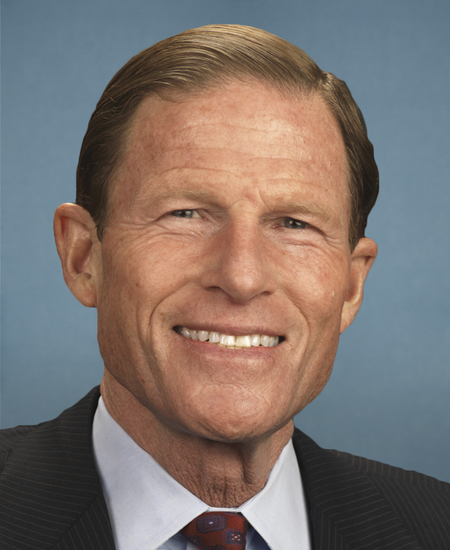
Blumenthal Slams Republican Attempts to Ignore the Reason for Jack Smith's Lawful Investigation: Trump's Incitement of a Violent Insurrection at the Capitol to Prevent the Transition of Power
[WASHINGTON, DC] – During a hearing today with former Special Counsel Jack Smith, U.S. Senator Richard Blumenthal (D-CT), a member of the Senate Judiciary Committee, underscored the seriousness of the events that predicated Smith’s investigations into President Donald Trump, including the violent attack on the Capitol on January 6, 2021. During his exchange with Smith, Blumenthal also ran through the lawful investigative steps that Smith and his team took in order to pursue the case, including seeking an indictment from a grand jury composed of everyday Americans. “I want to remind folks why we're here today. And I think a picture is worth a thousand words. We're here today because Donald Trump incited a mob to attack us—the Capitol, Members of Congress, to stop the counting of votes. He objected to the result of an election, and he tried to stop the peaceful transition of power by inciting rioters to attack the Capitol, including everybody here today,” Blumenthal said. “And we came to this very room on that day seeking safety, finding refuge. We were kept here for hours, and then we were given the choice to secretly go home, to leave here, as armed guards sought to protect us in this room, and I remember sitting over in that corner, trying to recharge my phone, so I could call my wife to tell her I was OK. That's what Donald Trump did on that day.” Blumenthal’s exchange with Mr. Smith is available here and a full transcript is copied below. U.S. Senator Richard Blumenthal (D-CT): Thank you, Mr. Chairman. Mr. Smith, thank you for being here. You're here voluntarily, correct? Jack Smith: Yes. Senator Blumenthal: You offered to come repeatedly more than a year ago, correct? Mr. Smith : I believe it was last October. Sen. Blumenthal: You didn't need to be subpoenaed to come here. You came here to tell your story. I want to give you the opportunity to respond to some of Senator Britt’s questions if you feel you have anything to add, because you were interrupted repeatedly. And I'm willing to take some of my time to give you an opportunity to clarify anything you'd like. Mr. Smith: Just very briefly, our nondisclosure orders were not predicated on the idea that Members of Congress or Members of this Committee would commit acts of obstruction. It was based on a real concern that Donald Trump and his associates would do that because they had done it, and they did it again. Donald Trump, in our case, in the elections case, later suggested that a witness, General Mark Milley, should be put to death. He said, “If you come after me, I'm coming after you.” Election workers in Georgia, Ruby Freeman and her daughter, faced vile, racist death threats because of the things that Donald Trump said and how he targeted her. We had an absolute basis to seek protection of our investigation from that sort of obstruction. Sen. Blumenthal : Pretty chilling stuff. I think everybody watching should be chilled by what you just recounted. I want to remind folks why we're here today. And I think a picture is worth a thousand words. We're here today because Donald Trump incited a mob to attack us—the Capitol, Members of Congress, to stop the counting of votes. He objected to the result of an election, and he tried to stop the peaceful transition of power by inciting rioters to attack the Capitol, including everybody here today. And we came to this very room on that day seeking safety, finding refuge. We were kept here for hours, and then we were given the choice to secretly go home, to leave here, as armed guards sought to protect us in this room, and I remember sitting over in that corner, trying to recharge my phone, so I could call my wife to tell her I was OK. That's what Donald Trump did on that day. And we decided, it was a really great moment in the history of this body, at least recent history, that we would not go home, that we would continue the counting of votes, and we decided—I was so inspired by this moment—Republicans and Democrats alike, all of them, that we wanted that transition of democracy to go forward, and it did. In spite of Donald Trump. I want to read to you what you told the House Committee: “Our assessment of the evidence is that the person most responsible for what happened on January 6, that he is the person most responsible for what happened on January 6.” He caused what happened. It was foreseeable to him, and then when it happened, he tried to exploit it in furtherance of the conspiracy. Do you stand by that statement? Mr. Smith: I do. Sen. Blumenthal : And you conducted this investigation, it lasted months, correct? Mr. Smith : That’s correct. Sen. Blumenthal: And you concluded that on January 6, Donald Trump directed an angry mob to the U.S. Capitol to obstruct Congressional certification of the Presidential election, correct? Mr. Smith: Yes. Sen. Blumenthal: And he exploited the rioter’s violence to delay the counting of the vote, correct? Mr. Smith: Correct. Sen. Blumenthal: It was the result of a criminal conspiracy that resulted from his denying the results of the 2020 election, correct? Mr. Smith: Yes. Sen. Blumenthal: And he knew those claims were false. Mr. Smith: Yes, that is what we alleged in our indictment, and that’s what we intended to prove in trial. Sen. Blumenthal: You intended to prove it beyond reasonable doubt, correct? Mr. Smith: Absolutely. Sen. Blumenthal: And you brought that indictment even though the standard was probable cause, because you had proof beyond a reasonable doubt. Mr. Smith: Yes, we had evidence from a variety of sources. As I mentioned earlier, we had Republicans who wanted Donald Trump to win the election, people who had hoped he would win, but who put country before party. We felt those would be very powerful witnesses. We also had law enforcement officers who sought to defend this Capitol, who put their lives on the line for our democracy. Those two would be very powerful witnesses. Sen. Blumenthal : And in fact, more than 140 were assaulted, correct? Mr. Smith: Yes. Sen. Blumenthal: Now, the inciting of that mob and the riot was following his attempt to induce state officials—this point is really important—induce state officials to ignore the true vote count and manufacture fraudulent state electors’ slates in not just one or two but seven separate states, correct? Mr. Smith : Yes. Sen. Blumenthal : And again, these charges were not brought by you personally, they were the result of a grand jury indictment involving, how many people sit on grand jury? Mr. Smith : Up to 23. Sen. Blumenthal: They’re everyday Americans, correct? Mr. Smith: Yes. Sen. Blumenthal: who hear all the evidence, and they make a judgment without fear of favor and their identities are protected, correct? Mr. Smith : Yes. Sen. Blumenthal: And this indictment was not the result of some extraordinary process. I'm a former federal prosecutor, I was U.S. Attorney in Connecticut, I was a state Attorney General in Connecticut. Indictments are returned by grand juries composed of 23 everyday Americans in the course of criminal proceedings throughout the country, and that’s the way the process works, correct? Mr. Smith: That is correct. Sen. Blumenthal: Now, there is something larger at stake here, I think, and I think you alluded to it. The reason why these criminal charges, and they are serious felony counts against Donald Trump are so important is deterrence. That is why conviction would have been important, and it was forestalled by forces beyond your control. But deterrence of criminal conduct is one of the valid goals of criminal proceedings, correct? Mr. Smith: Yes, it is. Sen. Blumenthal: And what we're trying to deter here is an attack on democracy—another assault on the Capitol or some other symbol of democracy, and more than a symbol, it is the fulcrum, one of the central points of our democracy. We want to make sure that this attack on our elections system does not happen again, correct? Mr. Smith: Yes. Sen. Blumenthal : So this criminal proceeding is not about personal retribution against Donald Trump. It really is, in a sense, a defense of our democracy to stop another attack on our democracy, correct? Mr. Smith: We brought the case based on the facts and the law. My view is that those facts, amply supported the prosecution we brought. Sen. Blumenthal: But you did not bring it as a matter of public policy, you brought it as a prosecutor following the facts and law, correct? Mr. Smith: That’s correct, as a prosecutor, I worked within the confines of my profession and the rules of the department, as well as the law. My job is to follow the facts and law and bring a case if it’s appropriate and not bring a case if it’s appropriate, and that is what we did. Sen. Blumenthal: I want to show you a picture, you're going to recognize it, even though I know it will be difficult to see. It comes from one of the indictments from the grand jury. It is of how Donald Trump stored classified documents in his ballroom and bathroom in his personal home. These were classified documents that he bragged were secret. He showed it to visiting journalists, he showed it to friends, and he stored it in this way, with the documents strewn across the floor, classified documents about American vulnerabilities to attack by our enemies and plans to counter those attacks. Is that the way classified documents ought to be stored, Mr. Smith? Mr. Smith: No. Sen. Blumenthal : And he was indicted by a grand jury for taking those classified documents without authorization and without safeguarding them in even the most minimal way. He did not even put them in a safe or in a closet. They were strewn across the floor, correct? Mr. Smith: The indictment lays out the allegations that we brought and that the grand jury voted. Sen. Blumenthal : Thank you for your answers to my questions, Mr. Smith. -30-
6694a88f-04e9-42cc-9b78-65017cd120faIssued within 24 hours
Other senators' releases published in the day before or after this one.