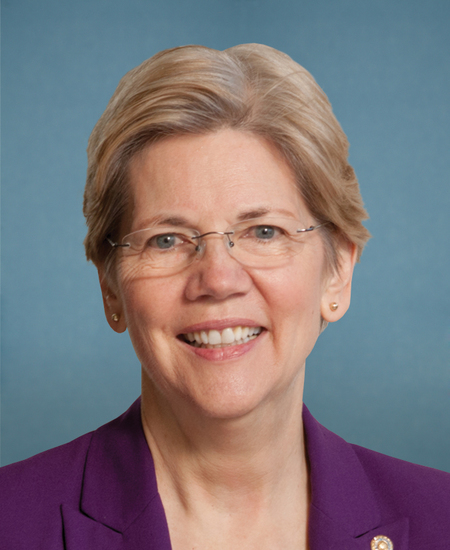
Warren, King Seek Data on Tax Break for Ultra-Wealthy Expanded by Republicans in One Big Beautiful Bill
One year after bill passage, lawmakers ask JCT to investigate tax break benefits Republican expansion of Qualified Small Business Stock exclusion estimated to cost taxpayers $17.2 billion Text of Letter (PDF) Washington, D.C. — U.S. Senators Elizabeth Warren (D-Mass.), a member of the Senate Finance Committee, and Angus King (I-Maine) wrote to the nonpartisan Joint Committee on Taxation (JCT), seeking information about the One Big Beautiful Bill Act (OBBBA) ’s expansion of the Qualified Small Business Stock (QSBS) exclusion , which is projected to cost taxpayers $17.2 billion. The request comes roughly one year after Donald Trump and Republicans in Congress fast tracked the bill’s passage. “[T]he QSBS exclusion is riddled with loopholes that are regularly exploited by the very wealthy…Given [the] flurry of recent QSBS-related policymaking, it is more important than ever for Congress and the American people to have updated data on the QSBS exclusion,” wrote the senators . The QSBS exclusion allows investors who buy stock in a “qualified business” to write off as much as 100 percent of their capital gains when they sell that stock, in some cases delivering millions of dollars in tax breaks. Though the exclusion has “small business” in its name, the vast majority of small businesses are ineligible to benefit . 94% of the value of the exclusions claimed from 2012 to 2022 went to households with over $1 million in income. Tax experts across the political spectrum have raised concerns about the exclusion being “inefficient, complex, and unfair” and a windfall for “the wealthiest U.S. taxpayers.” Others have noted it serves as a “narrowly targeted subsidy” for venture capital and arbitrarily advantages certain types of businesses, namely tech startups, while having “little if any positive incentive effects.” In OBBBA, President Trump and Congressional Republicans dramatically expanded the tax break, raising the cap on the size of a “qualified business” while shortening the period of time investors must hold stock before becoming eligible for the exclusion. These and several other changes to the QSBS exclusion will cost taxpayers an estimated $17.2 billion through 2034. The senators asked JCT to provide: A breakdown, by industry, of the businesses likely eligible to issue QSBS stock; The share of businesses issuing QSBS-eligible stock that have a market value over $1 million, $10 million, and $50 million; The share of taxpayers receiving the QSBS exclusion who made their investment through a private equity fund or venture capital fund; and The share of taxpayers claiming the QSBS exclusion who have income over $1 million and above the 90th, 99th, and 99.9th percentiles. Senator Warren has previously sought to have the nonpartisan Joint Committee on Taxation investigate how provisions from the Big, Beautiful Bill are a massive giveaway to the ultra-rich: In September 2025, Senator Warren (D-Mass.) wrote to the nonpartisan Congressional Joint Committee on Taxation (JCT), seeking information about the Big, Beautiful Bill’s permanent extension of 100% bonus depreciation , which previous research has shown is a giveaway to massive corporations. The tax break is a major windfall for giant corporations, by allowing them to write off the cost of new materials or investments immediately, instead of over the lifetime of those assets. JCT estimates that the permanent extension of this provision will cost a whopping $362.7 billion over ten years. In August 2025, Senator Warren (D-Mass.) published a new analysis from the nonpartisan Joint Committee on Taxation (JCT) revealing that President Trump’s “Big, Beautiful Bill” will deliver $67 billion in retroactive tax breaks to corporations in 2026. The JCT analysis comes in response to a June 2025 request from Senator Warren for information on Republicans’ legislation to effectively expand the size of tax breaks that corporations will receive for research they have already conducted. In June 2025, Senator Warren (D-Mass.) wrote to the Joint Committee on Taxation (JCT), a nonpartisan Congressional committee dedicated to analyzing tax legislation, asking the committee to provide information on the revenue impact of giving billionaire corporations retroactive tax breaks. In March 2025, in a new response to a letter sent by Senators Warren (D-Mass.), Cortez Masto (D-Nev.), Warner (D-Va.), Bennet (D-Colo.), and Welch (D-Vt.), the nonpartisan Joint Committee on Taxation (JCT) revealed the unprecedented nature of Republicans’ proposed “magic math” to pay for billionaire tax cuts and falsely claim no cost to American taxpayers. In February 2025, Senators Warren (D-Mass.), Cortez Masto (D-Nev.), Warner (D-Va.), Bennet (D-Colo.), and Welch (D-Vt.) wrote to the nonpartisan Joint Committee on Taxation (JCT), pressing for answers on the scoring methods used for tax legislation ahead of the expiration of many of the tax provisions contained in President Trump’s 2017 Tax Cuts and Jobs Act (TCJA). ###
75853608-fef1-42be-9798-1e2bb687fe66Issued within 24 hours
Other senators' releases published in the day before or after this one.