Trump tariffs to top agenda when Democrats take control: Strickland
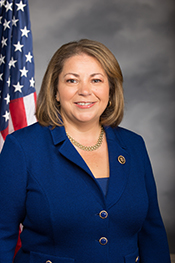
AJP: Trump tariffs to top agenda when Democrats take control: Strickland By: Lee Jung-woo Rep. Marilyn Strickland. Courtesy of Congresswoman Strickland’s Office SEOUL, November 16 (AJP) – Revisiting President Donald Trump’s signature tariff policy will be a top priority when Democrats take control of the House and Senate in January, said a veteran Democratic lawmaker recently elected to a fourth term representing Washington state. “One of the things we can do, because the Democrats will now control the House and the Senate, is to look at our tariff policy to ensure that it’s fair and that we are not doing anything that will harm our allies,” Rep. Marilyn Strickland said in a recent video interview with AJP. “I am very excited to share with you that Hakeem Jeffries, the incoming Speaker of the House, has said that dealing with tariffs will be one of the first things that we do in the next Congress,” said the lawmaker, who is one of the first Korean American women elected to Congress. Strickland was born in Seoul in 1962 to a Korean mother and an African American father who served in the U.S. Army. Poorly designed tariffs raise costs for American consumers and businesses, she argued, placing the treatment of trading partners at the heart of the affordability debate that helped shape the midterm elections. For South Korea, that debate bears directly on a trading relationship built on lowering barriers. The South Korea-U.S. free trade agreement, which took effect in March 2012, reduced or eliminated tariffs across much of bilateral trade. Trade in goods and services between the two countries totaled $241.6 billion in 2025, according to the Congressional Research Service. The November 2025 bilateral trade and investment deal established a 15 percent tariff framework for many Korean goods and lowered automobile tariffs from 25 percent to 15 percent in exchange for Korean investment commitments totaling $350 billion. The agreement followed Trump’s April 2025 “Liberation Day tariff” announcement in the opening months of his second presidency, part of the most sweeping tariff increases since the Smoot-Hawley Tariff Act of 1930. Strickland’s ties to South Korea are personal as well as political. “I tell folks that I am a proud Korean American, African American woman. I was born in Seoul and was raised by a Korean woman. I will always be a daughter of Korea.” When she took her first congressional oath on Jan. 3, 2021, Strickland wore a hanbok, becoming the first member to wear the traditional Korean attire at a congressional swearing-in, according to her office. She wanted her mother, watching on television during the pandemic, to be able to distinguish her among hundreds of lawmakers. Rep. Marilyn Strickland, center, wears a hanbok as she takes the oath of office at the U.S. Capitol in Washington, D.C., on Jan. 3, 2021. Screenshot from Strickland’s X account The choice also carried a broader message. Against a backdrop of anti-Asian hostility and rhetoric she described as racist, Strickland wanted to affirm that her Korean and Black heritage had a place in American public life. “It was important to demonstrate that, as a woman who is Korean and Black, I am proud of my heritage and that I am as American as anyone else is,” she said. “I wanted to send a message about what being American means, and my life experience is part of the American experience.” That connection informs a policy agenda spanning trade, industrial cooperation and the South Korea-U.S. alliance. Shipbuilding offers a point of agreement with the Trump administration. “Korea is so dominant when it comes to shipbuilding. I had the opportunity to visit Hyundai Heavy Industries and Samsung when I was in Korea recently,” she said. She was impressed by the scale of Korean shipyards, their workforce and the speed and quality of construction. The challenge for the United States, she said, is to draw on that expertise while training American workers and attracting investment in domestic shipbuilding. The November 2025 agreement earmarked $150 billion of South Korea’s $350 billion investment commitment for shipbuilding cooperation under the MASGA initiative, short for Make American Shipbuilding Great Again. The accompanying joint fact sheet called for cooperation on workforce development, shipyard modernization, maintenance and repair, and supply chains. In Washington state, the industry encompasses ferry construction and commercial vessel repair around Seattle and Tacoma, alongside naval maintenance at the Puget Sound Naval Shipyard in Bremerton. On the East Coast, Hanwha Systems and Hanwha Ocean completed their $100 million acquisition of Philly Shipyard in December 2024, giving the Korean group a U.S. production base. Strickland pointed to partnerships in the Philadelphia area as examples of cooperation that should bring together Korean investment and expertise with American manufacturing and jobs. She also linked shipbuilding capacity to security in the Ind
77d3553f-2e5f-4b8a-a880-4f0d483794ecIssued within 24 hours
Other senators' releases published in the day before or after this one.