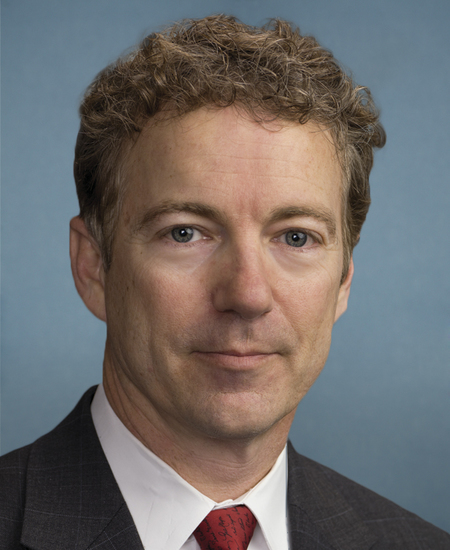
Senator Rand Paul Offers Amendment to Strip Half-Trillion-Dollar Tax Increase from Russia Sanctions Bill
FOR IMMEDIATE RELEASE August 7 th 2026 Contact: Press_Paul@paul.senate.gov , 202-224-4343 Senator Rand Paul Offers Amendment to Strip Half-Trillion-Dollar Tax Increase from Russia Sanctions Bill WASHINGTON D.C. — U.S. Senator Rand Paul (R-KY) today offered an amendment to the Lindsey O. Graham Sanctioning Russia Act of 2026, that strikes the Executive Branch’s authority to impose tariffs of up to 100 percent on an ever-changing list of countries. That authority would raise nearly $500 billion in new revenue effectively the largest tax increase imposed by a Republican Congress. The amendment keeps the bill’s broad sanctions authorities and the 500 percent tariffs on goods from Russia itself. It removes only the unconstitutional power to levy massive tariffs on American imports. Tariffs are taxes on imported goods paid by American families, retailers, and manufacturers. They are not paid by foreign governments. Recent tariffs have already cost the average American family more than $1,700. After delivering a tax cut, a Republican Congress would now raise prices on everyday goods, manufacturing inputs, and necessities—nullifying the benefits of that tax cut for parents, workers, and single mothers. You can read the amendment in its entirety HERE . Dr. Paul’s Remarks as Prepared: Increasing taxes on Americans will not end Putin’s war in Ukraine. The drafters of this legislation, understandably, wish to punish Vladimir Putin and send the Russian invaders back to where they came from. But this bill was written such that the drafters fail to see that it will not bring peace to Ukraine, but rather will deliberately make American families poorer by increasing tariffs, which are nothing but taxes on imported goods. To save Americans from what very well could be the largest tax increase imposed by a Republican Congress, I offer an amendment that strikes the authority to impose tariffs of up to 100 percent on an ever-changing list of countries. Congress should not delegate its constitutional duties to the Executive so shamelessly. My amendment does not touch the broad sanctions authority provided by the bill, nor does it touch the 500 percent tariffs on Russia because I see the strong desire among other members of the Senate to use economic warfare against Putin. But once upon a time Republicans were distinguished from Democrats by their persistent chant that the U.S. deficit was the result of a spending problem, not a revenue problem. Yet, today, many Republicans have become cheerleaders for more revenue. The bill before us grants the Executive Branch the power to raise nearly $500 billion dollars in revenue. I hope I am not the only Republican left in Congress who is horrified by a bill that proposes to raise taxes by a half a trillion dollars. In addition, there is that “little” constitutional issue. Can Congress delegate its Article 1 Section 8 authority to lay taxes and levies to the Executive Branch? The answer to that question is unequivocally no. Embedded within our Constitution is the non-delegation principle, which states that Congress cannot delegate its core legislative powers to other branches of government or private entities. The Supreme Court used to enforce the non-delegation doctrine, most notably in the Schecter Poultry case. But that case was decided in 1935 and, for much of the years that have elapsed between then and now, the Supreme Court has been a reliable ally to lazy legislators. Up until recently, the Supreme Court effectively relieved Congress from the hard work of legislating. But the tide is turning with the help of President Trump’s nominees. Justice Gorsuch forcefully made the case for reviving the nondelegation principle by arguing that if Congress “could pass off its legislative power to the executive branch . . . legislation would risk become nothing more than the will of the current President.” Additionally, the Major Questions Doctrine, which is strengthening with time, stands for the principle that if a federal agency is to make decisions on significant policy questions, it must be given clear authority by Congress. But, today, we are not presented with a question of vague direction within this legislation. The problem with this legislation is that it disobeys the clear command of the Constitution: taxes and levies must be determined by Congress. Moreover, taxation bills must originate in the House of Representatives. Do not let sympathy for Ukraine blind you to the reality of tariffs. Tariffs are taxes on imports that are paid by Americans. They are paid by parents trying to provide for their families. They are paid by students saving up to buy their first car. They are paid by anyone who seeks to spend money on any conceivable product. There will be those who will try to pull the wool over your eyes and tell you, despite the persistent sticker shock…despite the feeling that life just keeps getting more and more expensive, that tariffs are always paid for by someone else overseas. Those members who vote for this tax increase will tell you, “Not to worry, these tariffs will only be levied on mean foreign countries.” This absurd claim is laughable. Figuring out who pays the tariffs is easy. All you have to do is look to who are getting tariff refunds. And exactly who is getting paid back for the costs of tariffs? China did not get in line to get a tariff rebate. Neither did the United Kingdom, nor Canada, nor the European Union, nor any other foreign government. The entities that lined up for rebates after the Supreme Court struck down the emergency tariffs were primarily American retailers such as Walmart, Target, Costco and Nike. Let me repeat: China isn’t on the refund list, because China doesn’t pay the tariffs. American importers and retailers pay the tariffs, and they pass the cost of the tariffs onto you, the consumer. You don’t have to take my word for it. A letter was sent to the Senate Republican and Democratic Leaders by two dozen industry associations, including the Chamber of Commerce, the Consumer Technology Association, and the National Retail Association, warning about the costs of tariffs imposed by this bill. Here are some choice quotes from their letter: “ [T]he potential of new broad 100% tariffs on imports from secondary countries risks raising costs for American businesses, workers and consumers.” “That approach would effectively tax U.S. importers and consumers for foreign governments’ energy decisions — conduct that is outside the control of American companies.” “Tariffs of this scale would increase costs for everyday consumer goods, manufacturing inputs and other products while creating significant uncertainty for companies making sourcing, pricing and inventory decisions months in advance.” “It could also lead to retaliatory tariffs against U.S. exports, including agriculture.” “Tariffs … are a blunt tool that can penalize law-abiding U.S. companies importing legitimate goods, invite retaliation, complicate trade negotiations and shift costs onto American families without ensuring that pressure reaches the intended actors.” These two dozen associations end their letter by stating: “We urge Congress to remove the tariff authority from the bill and instead focus on targeted sanctions, stronger enforcement against sanctions evasion and coordinated diplomacy with countries purchasing Russian energy.” Anybody concerned with the economic wellbeing of American families would come to the same conclusion. But it’s not easy to find such common sense in the United States Congress. Imposing a 100 percent tariff on all goods imported from countries like China and India is the economic equivalent of shooting ourselves in the foot. Middle and low-income Americans enjoy a higher quality of life when they have more purchasing power for everyday necessities. Recent tariffs are estimated to have already cost the average American family over $1,700. And now a Republican Congress, after it just gave the American people a tax cut, seeks to make every good, every service, and every necessity more expensive and thereby nullify the benefits of that tax cut. What are we going to say to the parents buying their kids new shoes for the school year, the minimum wage worker who needs to buy a new part to fix their car so they can get to work, or the single mother buying diapers, when they notice that prices have doubled? But the costs of the tariffs are not strictly monetary. These tariffs threaten to undermine America’s strategic position in the world. Some naively think that tariffs will get China to distance itself from Russia, but recent history suggests they will instead push Russia and China closer together. Slapping a 100 percent tariff on China may inadvertently solidify its geopolitical alignment with Russia as Beijing would become more, not less, reliant on Moscow for economic and diplomatic support. Ryan Young, a Senior Economist with the Competitive Enterprise Institute points out that Russia is the junior partner in the alliance with China. Young reminds us that China agreed to a second natural-gas pipeline between the two countries on the condition that Russia sell China gas at a lower than market rate. China is not going to give up that discount because of this bill. But imposing tariffs on China will reignite the trade war. Beijing will certainly retaliate with their own tariffs and export controls. Maia Nikoladze, the Deputy Director of the Economic Statecraft Initiative at the Atlantic Council, reminded us that the Liberation Day tariffs placed on China in April 2025 didn’t change Beijing’s behavior. Instead, those tariffs prompted China to restrict exports of critical rare earth elements, which are necessary for defense and advanced-technologies, and subsequently caused mass disruption in U.S. and European supply chains. Likewise, imposing a 100 percent tariff on India, at a time when we are actively trying to court them to help us in our competition with China, is completely self-defeating. Ryan Young with the Competitive Enterprise Institute worries that imposing tariffs on India will alienate one of our most important strategic partners in Asia and potential counterweight to China. Instead, these tariffs may very well push India toward aligning with other economic blocs, including potentially a closer relationship with China and Russia. It is also unclear if tariffs could even be imposed on individual members of the European Union, like Slovakia and Hungary, given Europe’s common trade policy. In 2025, U.S.-EU bilateral trade was over $1 trillion. Trying to tariff individual EU countries directly undermines President Trump’s recent U.S.-EU trade agreement. Should the EU retaliate against the United States, the result will be disastrous for both American businesses and consumers. I encourage my colleagues to support my amendment that strips the counterproductive tariffs from the legislation. If not adopted, Congress should reject this strategic blunder of a bill that will do nothing to bring peace to Ukraine, but rather raise prices for American consumers, further weaken the dollar, destroy U.S. relations around the globe, and drive our adversaries closer together.” ### Related posts: Senator Rand Paul Joins Push for School Choice Sens. Paul, Booker Participate In Sullivan University Forum On REDEEM Act Sens. Paul And Boxer Announce The Invest In Transportation Act Sens. Paul and Booker Re-introduce the REDEEM Act
894c6b8e-d10e-4680-84ac-8d5fb13bbe3eIssued within 24 hours
Other senators' releases published in the day before or after this one.