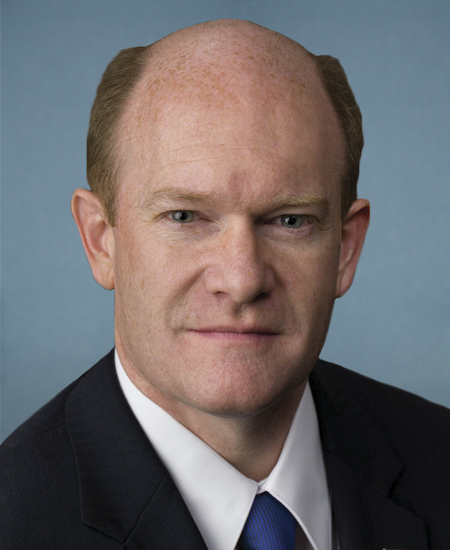
Senator Coons presses Attorney General nominee Todd Blanche on independence from Trump during confirmation hearing
WASHINGTON – U.S. Senator Chris Coons (D-Del.) questioned Todd Blanche, President Trump’s nominee for Attorney General of the United States, at his Senate Judiciary Committee confirmation hearing today, where he pressed Blanche on whether he would stand up to the president and highlighted Blanche’s past support for President Trump’s mass pardons for January 6 rioters who attacked Capitol Police officers. President Trump fired former Attorney General Pam Bondi in April, barely a year after taking office, amid reports that he had grown frustrated that the DOJ was not doing enough to prosecute his political opponents. Blanche, President Trump’s former personal attorney and Bondi’s deputy, took over as acting attorney general and is now seeking Senate confirmation to lead the department permanently. “You’re in charge of a Department of Justice I don’t recognize: prosecuting the president’s political enemies, firing rank-and-file prosecutors and FBI agents because of the cases they were assigned to, slashing grants for law enforcement and public safety,” said Senator Coons . Senator Coons also pushed Blanche on the proposed $1.8 billion “weaponization fund” he has tried to create for President Trump to reward political allies and President Trump’s blanket pardons of individuals charged in connection with the January 6 attack, including rioters who were convicted of assaulting law enforcement officers. Blanche struggled to answer questions about the pardons after Senator Coons confronted him with his own remarks at the Conservative Political Action Conference where Blanche “trumpeted [the pardons] as an achievement.” A video and full transcript of Senator Coons’ comments are available below. WATCH HERE . Senator Coons: Thank you, Mr. Chairman, Ranking Member. Acting Attorney General Blanche, thank you for your service and for appearing here. And thank you to your family and to the men and women of the Department of Justice who work tirelessly to fight crime and to make our nation secure, I’m grateful for their service. I’m sorry that your schedule apparently didn’t permit us to meet before this confirmation hearing, but I hope and expect we’ll find time to meet soon after today. Blanche: Absolutely. Senator Coons: Thank you. As I consider your nomination, like all other nominations to similar cabinet positions, I need to know you’re qualified to serve. You demonstrably are. That you have the policy views to serve well. We will discuss that today. And, most importantly in this role, that you have the independence to serve as the attorney general for the American people. And that last question has troubled me the most. You’re in charge of a Department of Justice I don’t recognize: prosecuting the president’s political enemies, firing rank-and-file prosecutors and FBI agents because of the cases they were assigned to, slashing grants for law enforcement and public safety. These are some actions that, in your previous confirmation hearing before us, you said you would not take. Now, I appreciate your statement walking back the $1.8 billion “weaponization fund” that you created, but I question how it got that far, and we’ll get into that. You sat in an appropriations hearing earlier this year before me and defended it at that time. In fact, if I remember correctly, you told me I was wrong for criticizing it. But following questions by Senators Durbin and Cornyn, I’m concerned it’s not dead yet, and I think we should talk that through. Overall, this is not what I believe the American people expect or deserve from the Department of Justice. Having spent critical parts of January 6 in this room taking shelter from the mob, I just wanted to open with some questions. How many people were convicted of assaulting law enforcement officers on January 6? Blanche: I believe around 120, approximately, but I could be off a few more. Senator Coons: You are. The answer is more than 200. And how many of those individuals had their sentences commuted or were pardoned by President Trump? Blanche: President Trump either commuted or pardoned every defendant from the January 6 events. Senator Coons: That’s correct. And in this room right now, and outside this room, are Capitol Police officers protecting us in this hearing room. How many of them do you think might have friends or colleagues who were attacked by supporters of the president on January 6? Blanche: I don’t know the numbers, but I’m sure many of the Capitol Police officers who are here today worked, either were working on January 6th, or knew people who were. Senator Coons: I’ll just say that I consider a shameful slap in the face of the men and women of law enforcement for those convicted of assaulting police officers to have been pardoned. I know you were not serving as deputy attorney general when President Trump pardoned those folks, but you said just a few moments ago that you were not celebrating this decision by the president. He was exercising his constitutional power. But earlier this year, in front of CPAC, a conservative event, I would say, from the transcript, you actually trumpeted it as an achievement. And I quote, saying, “If you look at what happened to the men and women convicted because of January 6, by 5 p.m. on January 20, every one of them was either pardoned or had their sentence commuted by President Trump. So, when folks say you’ve done nothing, I say you have a very short memory.” Would you say that you’re proud of President Trump’s decision to pardon individuals who assaulted law enforcement? Blanche: No, that’s not what I was saying there at all, Senator. So, I was responding to inquiries around why more hadn’t been done by the Department of Justice with respect to January 6 defendants. And so, my answer was that the January 6 defendants and some of their lawyers had a short memory because a lot had already been done. Indeed, by the end of the day on January 20, they had all been pardoned or commuted. So, I wasn’t celebrating it. I was merely stating a fact, which is that the January 6 defendants did receive a very generous pardon or commutation from President Trump. Every one of them on January 6. Senator Coons: A generous – and in my view, for those who had assaulted police officers – unwarranted, unjustified, ahistorical, and a terrible precedent. Let me move on to questions I’ve asked in previous hearings. Is President Trump, just as a simple matter of constitutional law, eligible to run for another term as president in 2028? Blanche: I don’t believe he is. No. Senator Coons: That is correct, in my view, reading of the plain language of the 22nd Amendment. Why do you think several of the judicial nominees of this administration have refused repeatedly to answer that question simply and clearly, as you just did, when I put it to them? Blanche: I have no idea why they answer questions. Senator Coons: Me neither. It was confounding. Blanche: You are asking me to speculate about something I don’t know. Senator Coons: Is the Department of Justice that you are running independent from the White House? Blanche: The Department of Justice, like every single department in the executive, is part of the executive. I mean, Article II of the Constitution gives the power of the executive to President Trump. So, we certainly operate with integrity. We certainly operate in the single mindset to serve the American people and do the right thing. But I am a member, if confirmed, I will be a member of the cabinet. I’m serving in the acting capacity that way now, just like the other cabinet members. And President Trump can fire me whenever he wants, so… Senator Coons: Do you have a sense why he fired your predecessor? Blanche: I have no idea. President Trump, we all serve with the pleasure of President Trump in this administration. Senator Coons: Did President Trump ever post on Truth Social directing your predecessor to get at it, to prosecute his perceived political enemies? Blanche: I don’t think those were his exact words, but no. Senator Coons: Those were not his exact words, but I thought it was the intention. It is my impression, sir, that you are here rather than your predecessor because the president was unhappy with her failures to actually secure convictions of folks like Attorney General Tish James or former FBI Director Jim Comey. If you’re confirmed and you’re asked to take an action you believe to be illegal or unethical, would you resign? Blanche: That will never happen. But yes, if it were to happen, I’m not going to violate my oath to the Constitution. Senator Coons: I appreciate that answer. You did answer a question by a colleague about input that you gave to the president. Did you ever say no to the president on the slush fund, the anti-weaponization fund? Did you advise him against this? Blanche: I am not, will not, talk about communications I have with the president. I served as his lawyer for a couple years before he was elected. I’m the deputy attorney general and the acting attorney general, so I’m not going to talk about communications that I have with him. But, Senator, I will say that President Trump trusts me to give him counsel. Counsel does not mean a recognized man, and so that’s, and that’s true in my case, like it should be in any attorney general’s case. Senator Coons: Let me just, for a minute, bear down on the anti-weaponization fund. You’ve testified to the House: “We are not moving forward with that fund, period.” But you’ve repeatedly refused to put that commitment in writing or to submit a declaration to the court. You’re an officer of the court, a member of the bar. You should be able to make that assertion in a court filing or even in a letter submitted to this body. On May 19, you testified before the Justice Appropriations Subcommittee, “Since the case had been dismissed, there was no judge and no mechanism for judicial review.” But in an opinion this week, a federal judge wrote, and I’m quoting, that your testimony was “at best misleading and at worst disingenuous,” explaining the court remained available to review this agreement had you sought relief. Why not seek review of the settlement agreement or submit some record, some writing, given that the president continues to publicly champion this weaponization fund, and given your previous answer to me in another hearing that you wouldn’t say whether or not those who assaulted cops on January 6 would be eligible for multimillion-dollar payouts? Blanche: So, there’s a lot of questions there. First of all, we have put it in writing. It’s in repeated court filings in EDVA and D.C. So, this narrative that you won’t put it in writing happens not to be true. The reason why neither myself nor Secretary Bessent agreed to put a declaration in is because there’s long-standing precedent that judges cannot ask cabinet secretaries or people like me to put in declarations. It has nothing to do with whether the fund is alive. I’m under oath today, and I’ve said it’s dead repeatedly. I said it to the House Oversight Committee, and I am happy to say as many times as necessary. As far as what the judge said in Florida, just the last question you asked about Florida, that judge disagreed with what I said. I still believe that 11th Circuit precedent, which I’ve studied, I am right. So, we’ll see. Senator Coons: You did say earlier, “This is the most transparent Department of Justice in American history. We have nothing to hide.” And you started by saying, “We’re here to rebuild trust.” Two decisions, or two OLC opinions, I’m very interested in. I’m the senior Democrat on defense and intelligence appropes. I’m the most senior member of the Foreign Relations Committee on my side who’s currently serving on this committee. I’m curious as to why the most transparent department has refused to release the OLC opinion that justifies the 66 strikes the military has conducted on boats in the Caribbean, which have killed more than 220 people, either a redacted version or in a classified setting to me and others who are in relevant decision-making positions. Blanche: Well, Senator, we made the head of OLC available on multiple occasions to explain that to you and other members of the committee, and that is extraordinarily transparent and unprecedented that we’ve done that. Whether an OLC opinion is released, there’s a lot of process that goes into that. But the idea that we were not transparent about our legal basis there is absolutely not true. Senator Coons: Okay, another chance to be transparent: The FISA court in March certified your Section 702 proceedings but found compliance deficiencies. This is an important power of the federal government that will soon be up again for vote, and you have not declassified that opinion. Senators Cotton and Warner, Republican and Democratic leads on Intelligence, in April wrote the administration saying that they expected declassification of this March opinion within two weeks. Yet it remains classified. You have a bipartisan request from the leadership of Intel. Will you declassify it or make it available to us? Blanche: We’ll continue to look at that. I agree with you that that’s a very important issue, and we need 702 reauthorized. Senator Coons: Thank you. Last question, if I could. The Safer Supervision Act is co-sponsored by Senators Lee, Cornyn, Tillis, and Lankford, and it gives a path forward to making sure that federal probation and parole is more effective. We’ve discussed it before. Will you meet with me to talk about ways that this important criminal justice reform, supported by federal law enforcement, could move forward? Blanche: I think it’s, yes, absolutely. I very much agree with what you’re trying to do there, Senator. Senator Coons: Thank you.
8cac05dc-edb3-4772-85ac-23b49330be42Issued within 24 hours
Other senators' releases published in the day before or after this one.