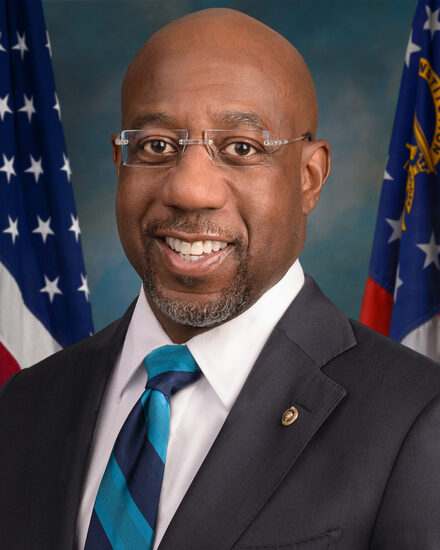
Warnock Speaks to Atlanta Press Club on Voting Rights, Gerrymandering, Affordability
Senator Reverend Warnock spoke to Atlanta journalists and business leaders about a wide range of issues facing Georgians as part of The Atlanta Press Club’s 2026 Newsmaker Leadership Series The conversation was moderated by 11Alive’s Political Reporter and Anchor Zach Merchant Senator Warnock: “I will work with anybody who will work with me to do something that will help the people of Georgia, and I will stand up, as I do, and take the President and members of his cabinet and his congressional enablers, I will take them to task when they are doing things that are hurting my constituents” Photo courtesy of Krys Alex Photography/FLIdP Above: Senator Reverend Warnock at the Atlanta Press Club’s 2026 Newsmaker Leadership Series Atlanta, GA – Last week, U.S. Senator Reverend Raphael Warnock (D-GA) addressed Atlanta journalists and business leaders as part of the Atlanta Press Club’s 2026 Newsmaker Leadership Series. Senator Warnock was joined on stage by 11Alive Political Reporter and Anchor Zach Merchant, who moderated a 45-minute conversation over a wide range of topics including the recent United States Supreme Court’s Callais decision, Georgia’s gerrymandering plans, affordability, and education. Here are some excerpts from the conversation: On U.S. Supreme Court Callais decision Senator Warnock has been a vocal advocate for voting rights, even before he became a U.S. Senator. In recent weeks, he has also traveled to Savannah and Montgomery, Alabama to speak out against the Callais decision and encourage people to continue fighting for voting rights. “ Democracy is the house we live in; it is the framework in which we get to fight for the things that matter, and honestly, this is a sad moment in the history of our country. The decision by the Supreme Court is a devastating blow to our democracy. The implications are massive and far-reaching ,” said Senator Reverend Warnock. Senator Warnock highlighted how the Georgia Governor Brian Kemp has called for a special session on June 17 to redraw political maps in the state instead of working to lower the cost of housing or health care. “I wish that they would come back in June and, rather than focus on expanding their power, they expand Medicaid. That will go a long way for the people of Georgia,” said Senator Reverend Warnock. Senator Warnock has introduced legislation that would ban partisan gerrymandering across the country. He has also been focused on passing the John Lewis Voting Rights Advancement Act and the Freedom to Vote Act , which would allow people to have a say in their elections. On America’s spiritual crisis For months, Senator Warnock has offered a unique perspective on the spiritual and affordability crises plaguing the United States. Last Thursday, the senator argued that the ongoing affordability crisis has created a spiritual crisis in America, but the problem has been ongoing for years and through both Republican and Democratic administrations. Senator Warnock: “ While Donald Trump is a problem, he’s also a symptom. The problem has been with us for a long time. I think that over the last few decades, over the last 40 years and more, the people of our state, the people of our country, have seen a growing pattern between what they would reasonably expect from their government and what government has been able to deliver. The government can’t deliver all things, but there are some things we expect the government to deliver. We’ve seen growing wealth inequality, and that gap has gotten larger and larger, and that gap has grown across Republican and Democratic administrations.” Senator Warnock on the despair the country is experiencing: “There’s a deep kind of despair that sets in, and sometimes cynicism like gangrene and the body politic, and I think that that sets the context for somebody like Donald Trump to emerge, not once but twice. He is the product of a deep disillusionment and hopelessness that has infected our country and led us deeper into the spiritual abyss, as he tells us that our problem is our neighbor. If you want to know the source of your problem, it’s that guy, that person over there, whom you ought to see as the other. And it spirals more and more so in that sense, while I am engaged in the work of politics, I do think that the puny language of partisan politics is too puny a vocabulary for what really ails us and what we need as leaders who remind us of who we can be when we stand together.” Bipartisan work Senator Warnock has been ranked as the 14 th most bipartisan member of Congress . The Senator has expressed that he will continue to work with his Republican colleagues in the Senate for anything that helps Georgians. Senator Warnock on working with Republicans in Congress: “I will work with anybody who will work with me to do something that will help the people of Georgia, and I will stand up, as I do, and take the President and members of his cabinet and his congressional enablers, I will take them to task when they are doing things that are hurting my constituents.” Housing During his time in the Senate, Senator Warnock has and continues to advocate for more housing and the ability for ordinary people to achieve the American dream of owning a home. The 21 st Century ROAD to Housing Act , which passed the Senate 89-10 and is currently in the final stages of negotiation, includes provisions that will limit how many properties private equity firms can own, as well as encouraging and incentivizing the building of more homes for renters and homeowners. Senator Warnock on the housing bill: “ Let me just say this: while I’m proud of this housing bill, it’s a good start. We’re 5 million units short. And there come moments in government where you really need government to lean in to get something moving. And so I’m proud of this bill. It doesn’t go big enough. I’d like to see us go bigger. I’d like to see us do the kind of things that government sometimes has to do to spur growth, maybe even get into constructing homes and selling them to the American people. I think we’re going to have to think outside the box and work our way out of this problem. ” Education Senator Warnock is the product of good public policy, going from a Head Start baby to an Upward Bound kid before attending Morehouse College. He has since earned four degrees and a PhD and continues to advocate for affordable education for all Georgians. Senator Warnock on increasing student debt: “These kids are coming out, and they’re just buried in debt. They’ve got a mortgage before they get a mortgage. So instead of giving billionaires a tax cut, which they don’t need…Instead of burdening all of us with these tariff taxes, which are a drag on the manufacturing sector, losing manufacturing jobs at a clip ever since Trump’s so-called liberation day, we should be finding ways to make sure that every child in America has a chance…I just want to make sure that every child growing up in some housing project in Atlanta, kids growing up in Dalton, Georgia, kids growing up in Appalachia, kids growing up on reservations, indigenous people of this land, and every child has a chance. I think that’s good, not only for that child, but that’s good for all of us. What I’m saying is, I want America to win. I love this country. For all of its flaws, and I’m mad at what’s happening right now…I love this country, and I want to see us win.” Senator Warnock’s Pathways to Prosperity Act aims to connect technical schools to industry leaders to provide apprenticeships so students can earn while they learn, so once they’re out of school, they’re immediately connected to jobs. “There is a whole range of jobs, but we have not done a good enough job of making sure that young people, regardless of what zip code they come from, have access to the pathways that lead to those jobs. I was able to pass legislation to address that, and I spent a lot of time thinking about workforce development,” said Senator Reverend Warnock. The event was held at The Retreat at The Gathering Spot in West Midtown and with Community in Schools of Atlanta serving as the event title sponsor. A transcript of Senator Warnock’s conversation can be found below (lightly edited for clarity): Zach Merchant: It’s hard to prep for these kinds of conversations because it feels like every time you start chopping down some notes, something new happens. So let’s start with the news that just came out yesterday. You’ve been vocal talking about the US Supreme Court’s Callais decision, the possibility of redrawing district maps across the country, across the southeast. Just about 24 hours ago, Governor Kemp called a special session, and lawmakers are coming back to Atlanta on June 17. One of the topics in front of them is potentially redrawing Georgia’s congressional and other legislative maps. What’s your message to lawmakers as they gear up for this special session? Senator Reverend Warnock : Thank you so much, Zach, and it’s great to be here at the Atlanta Press Club, and I just want to congratulate Community in Schools; they’re outstanding. Give them a round of applause. Listen, I talk a lot about voting rights and about our democracy, because while there are a whole range of issues that we fight for, we fight for our children, we fight for our seniors, and their ability to retire with dignity. Democracy is the house we live in; it is the framework in which we get to fight for the things that matter, and honestly, this is a sad moment in the history of our country. The decision by the Supreme Court is a devastating blow to our democracy. The implications are massive and far-reaching. We were already in this gerrymandering race to the bottom, arms race to reapportion them. I didn’t hear these sirens until I started talking. The Republicans have all kinds of tricks. But seriously, it’s really not surprising, but deeply disappointing that the Supreme Court decided to pour fuel on the fire started by Donald Trump when he called into Texas and said, ‘Give me six more seats’, all the things I can think of a president asking people to deliver, delivering him six more seats shouldn’t be on the list. So it’s unfortunate that Georgia now joins other southern states in this gerrymandering race to the bottom. My message to the Georgia legislature is this: if you would actually do something to help the people of Georgia, you won’t have to keep drawing the lines to manage the power of the people. Apparently, some folks are afraid that they’re going to be held to account come November. I think if you’re confident in the policies you’re putting forward for the people, you don’t have to keep redrawing the lines. That’s what the Republicans are doing, and I wish that they would come back in June and, rather than focus on expanding their power, they expand Medicaid. That will go a long way for the people of Georgia. ZM: I want to talk about health care in a moment. I suspect a lot of folks here are curious to hear your stance on that. But as we talked about gerrymandering, you used the phrase it’s a race to the bottom. You point to President Donald Trump pushing to redraw the maps in Texas. Democrats have responded in other Democratic leaning states in the country, in Virginia and California. If this is a race to the bottom? SRW: Let me be really clear about what’s happening here. I don’t like gerrymandering. I don’t like partisan gerrymandering. I don’t like racial gerrymandering, and I’m not just saying I don’t like it. I put my work into this effort. I have bills that would ban gerrymandering. It’s deeply problematic when you’re in a situation where, literally, we’re turning the democracy upside down, so that rather than the people picking their politicians, the politicians are busy picking their voters. That’s what this is about. And so if I had (my way), we would ban it, and we got legislation to that effect. Nobody’s hands are clean here. Both parties have engaged in gerrymandering, but I have to tell you, Republicans have been a lot better at it than we have, and they’ve been rabid and shameless. They have literally introduced a situation where the voting practices of the Jim Crow era are now a 21st-century fight, and that saddens me. I’m a Senator, I’m a pastor, but I’m the father of a nine-year-old and a seven-year-old. All of my life, I’ve lived under the protections of the Voting Rights Act. It’s been gutted, and they have less protections than their dad. We’re moving in the wrong direction. So here we are, as we go into the midterms, the people will get a chance to have their say. The gerrymandering that we’re seeing in Tennessee and Alabama, this cycle in Louisiana, would seek to mute and diminish their voices. If we’re in power, I would be focused on passing the John Lewis Voting Rights Advancement Act and the Freedom to Vote Act so that we get focused on making sure that the people have their say. ZM: In recent months, you spent time in conversations not dissimilar to this one, talking about what you call a spiritual crisis in America. What do you mean by that? SRW: This is a moral moment, and while I’m engaged in the work of politics, my first vocation is pastor, and as I see it, our country is in a moral crisis. There’s a spiritual (crisis) from the top all the way down. And while Donald Trump is a problem, he’s also a symptom. The problem has been with us for a long time. I think that over the last few decades, over the last 40 years and more, the people of our state, the people of our country, have seen a growing pattern between what they would reasonably expect from their government and what government has been able to deliver. The government can’t deliver all things, but there are some things we expect the government to deliver. We’ve seen growing wealth inequality, and that gap has gotten larger and larger, and that gap has grown across Republican and Democratic administrations, and the things that Americans agree on, on the left and the right, they can’t get done, because the voices, which is why I focus so much on democracy and voting rights, the voices of ordinary people have been squeezed out of their democracy as we witness the outsized impact of corporate interests in our politics and special interests are obvious. Even when we agree on things, there are divisions in this country, but our country isn’t as divided as our politics. The country isn’t as divided as you would think, looking at what we’re able to get through Congress. For example, according to a Fox News poll, take note of that, that’s the last time, but according to a Fox News poll, 78% of Americans believe that there ought to be some kind of universal background check. We can’t even get a vote on that on the floor of the Senate. That’s because increasingly, Americans see it, somebody else owns the democracy, and the voices of ordinary people are being squeezed out of democracy. As people witness this divide, as they see themselves working harder and harder and seeing less and less for their hard work, as young people wonder if they’ll ever be able to afford a home in a country where the average age of the first time home buyer is 40 and old people wonder if they should pay for their medicine or their food, and whether they’ll be able to retire with dignity. There’s a deep kind of despair that sets in, and sometimes cynicism like gangrene and the body politic, and I think that that sets the context for somebody like Donald Trump to emerge, not once but twice. He is the product of a deep disillusionment and hopelessness that has infected our country and led us deeper into the spiritual abyss, as he tells us that our problem is our neighbor. If you want to know the source of your problem, it’s that guy, that person over there, whom you ought to see as the other. And it spirals more and more so in that sense, while I am engaged in the work of politics, I do think that the puny language of partisan politics is too puny a vocabulary for what really ails us and what we need as leaders who remind us of who we can be when we stand together. ZM: I’m curious for your thoughts on this, because you’re talking about a problem here, in your view, that goes beyond partisan politics. But also, you’ve talked about wanting to and feeling that you need to push back on the Trump administration, on Republicans in the Senate, in the House. How do you do both of those things? How do you go beyond the politics, but in your view, also fight for the Democratic priorities that you stand for? SRW: What you do is you center it on people, and that’s what I spent my whole life doing. I’m a pastor. I still return to my pulpit every Sunday morning, and something about preparing sermons every week and talking to ordinary people, I think, keeps me grounded, at least, that’s my hope. I decided I wasn’t going to leave my church because I got elected to the Senate. I don’t want to spend all my time talking to politicians, so I returned to my church, and I work with Republicans where I can. I’m listed as the 14th most bipartisan senator in the Senate. I think when I won in my special election, and I had a high bipartisan score…The lower the number, the better. I do a lot of bipartisan work. And I think there are a lot of folks who thought that once I was reelected to a full six-year term, that could change. My score got better after I was reelected. So here’s the thing, I will work with anybody who will work with me to do something that will help the people of Georgia, and I will stand up, as I do, and take the President and members of his cabinet and his congressional enablers, I will take them to task when they are doing things that are hurting my constituents. ZM: You brought up the topic of affordability. I think everybody in this room who’s watched any minute of TV or YouTube, or anything, has seen so many campaign ads about every kind of politician running for office, talking about affordability one way or another. It’s a big topic. I think one place to maybe ground our conversation in that topic is something you brought up, which is housing and the rising cost of housing. Now, it is more difficult than, certainly, a generation, maybe more than, for young people to buy their first home. What should the Senate do? What can the Senate do? What can the US government do to make housing more affordable in our country? SRW: Well, housing is a major issue. It’s something I’ve been focused on for a long time. I know what it’s like to be you know, I grew up watching my parents dream about being a homeowner, and that dream didn’t come true for them until I left home to go to college, and so I understand the struggles of ordinary people. Even in this dark and difficult moment, every now and then, you get a glimpse of hope. I’m on the Senate Banking, Housing, and Urban Affairs Committee, and we recently passed out of the Senate something called the Road to Housing bill. And it’s a big deal. It passed the Banking, Housing, and Urban Affairs Committee unanimously. It’s a big deal. I mean, Tim Scott is the chair of the committee. Elizabeth Warren is the ranking member. Tim Scott and Elizabeth Warren went into a bar one day, which sounds like a bad joke, and they came out with a housing bill. And when you do bipartisan work like that, it means everybody gets something they want, and everybody they get some other things that they can’t get because you’re working with people on the other side. That’s how it works. But it’s the first housing bill to pass our committee in a decade or more. I’ve got a lot of good provisions in it. It’s going to go a long way with addressing our housing crisis. Our housing crisis, much of it is really on the supply side. Reason why housing is unaffordable? There’s not enough. We’re about 5 million units short. And so we put together a bill that’s got a number of different tools, or one tool, to try to encourage and incentivize the building of more homes, both for renters and homeowners. I got great provisions in that bill that will incentivize people. One of the issues we have, for example, in blue districts and red districts, places that are under Republican control and Democrat control, is these old housing covenants that are so restrictive that they come from a different era, making it really difficult to think outside of the box about how to create what’s necessary. So we incentivize municipalities, we incentivize cities to be more flexible about how we get housing. NIMBYism is killing us, and we just can’t get enough housing built, so there are various incentives in that bill that address that. I’m proud of one of my provisions, which addresses a real problem we have here in the metro Atlanta area, and that’s private equity swooping into communities and literally just prying up huge packets of housing. I say packets because that’s what it is for them. If you’re looking for any house, then it’s just one line on a spreadsheet. And sadly, our tax code is incentivizing a lot of that behavior. And so I have a provision in the Senate portion of the bill that caps what private equity can do. It would mean that all the major institutional investors that are dominating the housing market in Atlanta, they can’t buy another unit without being hit with a major fine. Donald Trump has signaled that he agrees with me on this issue. Imagine that, Donald Trump and I working together, but he’s signaled his agreement with this, the folks in the House have some issues, so y’all pray for the folks in the House, and hopefully we can get this legislation passed and get it to his desk. Let me just say this: while I’m proud of this housing bill, it’s a good start. We’re 5 million units short. And there come moments in government where you really need government to lean in to get something moving. And so I’m proud of this bill. It doesn’t go big enough. I’d like to see us go bigger. I’d like to see us do the kind of things that government sometimes has to do to spur growth, maybe even get into constructing homes and selling them to the American people. I think we’re going to have to think outside the box and work our way out of this problem. ZM: You teed up what I want to ask you about next really well, which is that there are a lot of big looming, thorny topics that are coming before Congress right now. The shortage of roughly 5 million homes is one of them. We also know it’s no secret that AI is exploding. The power and efficiency of artificial intelligence, and the ability to do a lot of stuff, are growing. A lot of people are excited about that, excited about the possibilities. There are also a lot of people who look at this and worry that the jobs that they currently do and take pride in and earn a living from could perhaps soon be taken away, be automated. Do you think Congress, do you think the US Senate is equipped to tackle this rapidly evolving technology and regulate it in a way that you think it should be regulated, that would protect people? SRW: AI obviously isn’t going anywhere, and we have to be clear-eyed about both the promise and the perils of AI. I don’t want to just dwell on the negative. There’s been a lot of innovative technology; you can’t stop innovation. You have to regulate it, and you have to be forward-looking and think about what the outcomes are that you want, and you have to get smart people around the table, who know what they’re doing and know what they’re talking about, advising on how to get the policy right. I’m somebody who likes to have smart people around me who actually know what they’re talking about. If I hired a Health and Human Services secretary, well, that’s a different conversation. But I’m talking to folks in the AI space now. I’ve convened them. I’ve pulled together my own kitchen cabinet, and I’m having ongoing conversations about AI, because there’s no part of our lives that is not going to be touched. Even the people in this room, the journalists, are seeing the impact of AI on their field, these huge language models that draw on your work, and which you may not get any credit or any benefit from. What do we do about all that? I think we’re moving way too slow. My friends who are in the technical field are working with AI all the time. They are flabbergasted by how quickly it changes, and you have these learning algorithms that the agents learn, and now the AI agents are talking to each other, and we have these huge data centers that are being built, and the implications of that on local communities, water, and the power grid. I was able to secure $50 million to help local communities and explore the impact of AI on their infrastructure, on energy, on water, just a whole range of issues around privacy, facial recognition, certainly huge national security implications, and the ability to attack infrastructure. I mean, there is a whole range of really scary scenarios. And then there’s the promise of a cure for cancer, because of the speed with which the technology can move and synthesize information. Here’s the thing that we can’t afford. We cannot afford, in this moment, in which we are faced with fierce global competition from China and other global competitors and adversaries, we cannot afford to be waist-deep in culture wars, and we just spend too much time in fights about nonsense or the ways in which we differ. And there are political actors who traffic in that. They encourage that because they don’t have a vision. People who have no vision, traffic in division, and while they’re busy encouraging the fight between ordinary Americans and we’re at each other’s throats and buying into these culture wars, nothing is getting done, certainly not quickly enough on something like AI, and wealth is being transferred from the bottom to the top. ZM: With all due respect to the Senate, the body you are a part of, I don’t think it’s a secret that it is a group of legislators who tend to skew a little older, not historically a group of lawmakers who are sitting often at the front of regulating emerging technology with the regulations that largely apply to the internet and they were written for an internet that was 20-25 years ago and we’re still working off that legal framework. Is the Senate, is the U.S. Congress, capable of tackling these issues fast enough that they can be in front of these emerging trends? SRW: That’s the big challenge of this moment, and I’m up for the challenge. I mean, part of what you’re asking, I mean, it’s about the Senate, but part of what you’re asking is, can democracy adapt itself to the reality of a shifting world, where things are moving so quickly? ZM: Are we keeping up right now? SRW: I would say that my vote is always with democracy, which is why I’m fighting for us to be more democratic, because I think authoritarian regimes, in the end, are not good for the people; that’s a losing proposition. I think the Senate can move. The question is, will it adapt itself to change quickly enough? That’s the question of the moment. I’m certainly doing everything I can to push my colleague. The reason why I do so much bipartisan work is because when you’re trying to solve real problems, that’s the only way to do it. And I look forward to a day when there’s a Democrat in the White House, because I think part of what we have seen, sadly in a tragic way with Donald Trump, is the power of the executive to use the authorities of the federal government to encourage. Sadly, they’re using them in ways that I think are harmful, that divide us, and emphasize that would take us backwards. But I think, I think that there, there are ways in which you could use the power of the executive to push Congress along. ZM: I want to ask you two last questions before we open it up to questions from the audience here. The first is this: we have a lot of folks who work in the education space here in the audience tonight, a lot of attention, rightly so, among this next generation of learners who are coming up right now. If you look at the state of education policy in the country, what are we getting wrong right now? What needs to be done? SRW: You see me here on stage. I’m a United States Senator. I’m the senior pastor of an iconic church, but I’m never far from that kid who grew up on Cape Street. I think about that. I grew up in public housing, number 11 out of 12 kids. The first college graduate, and I know that when you look at me, you’re a product, and certainly I worked hard, but you’re also looking at the product of good public policy. As a preschooler, I was a Head Start baby, the federal program that introduces preschool-age kids to learning. From the Head Start kid, and then in high school, my principal called me to her office. I thought I was in trouble. She wanted to tell me about this program called Upward Bound, and Upward Bound put a kid who was growing up in public housing on the campus of Savannah State College every Saturday for academic enrichment. Then, for six weeks during the summer, I lived in a dormitory…Then I wanted to go to Morehouse College because that’s where Dr. King went; I just wanted to attend school. But the year I went to Morehouse, the tuition, room, and board at Morehouse was more than what my family lived on. Pell grant, low-interest student loans, and work-study, I had a path…What keeps me up at night is the recognition that it would be harder for me to do today what I did all those years ago. The path for that kid who grew up on Cape Street, because somebody gave me a path, Cape Street is now named Raphael Warnock Way. I think about that kid, and I just want us to get the policy right to provide programs like Communities in Schools that will give them the support that they need. We shouldn’t be talking about getting rid of the Department of Education. We should be digging in. Yes, we do need to get the cost of college under control, because while I supported the loan forgiveness that we did under the Biden the administration, by the way, I already paid off my loans which also points out the difference, I got four degrees, I earned four degrees, and at the end of the day, I’only accumulated $30,000 of debt, which I paid off. These kids are coming out, and they’re just buried in debt. They’ve got a mortgage before they get a mortgage. So instead of giving billionaires a tax cut, which they don’t need…Instead of burdening all of us with these tariff taxes, which are a drag on the manufacturing sector, losing manufacturing jobs at a clip ever since Trump’s so-called liberation day, we should be finding ways to make sure that every child in America has a chance. That’s my work every day. I don’t care what you call it. If you want to, you can call it something else. I just want to make sure that every child growing up in some housing project in Atlanta, kids growing up in Dalton, Georgia, kids growing up in Appalachia, kids growing up on reservations, indigenous people of this land, and every child has a chance. I think that’s good, not only for that child, but that’s good for all of us. What I’m saying is, I want America to win. I love this country. For all of its flaws, and I’m mad at what’s happening right now…I love this country, and I want to see us win. ZM: If I went back to my newsroom and I didn’t ask this question, there’d be a lot of people upset with me. You talked about looking forward to having a Democratic executive in the future, you got a new book coming out soon…you got a new framework in the way you look at and categorize the state of the country, are you thinking of running for the White House in 2028? SRW: I am focused on 2026. I want to make sure we sent Jon Ossoff back to the United States Senate. I think he and I make a great duo. I like that Georgia elected its first Black senator and its first Jewish senator in one fell swoop, and I look forward to us continuing to work together. I’ll be focused on my race come 2028. ZM: That didn’t sound like a no. SRW: You sound like my nine-year-old daughter. ZM: Your nine-year-old daughter sounds like she will be a great journalist one day. SRW: I’m running for Georgia. Audience Question: Maria Saporta with the Saporta Report and co-chair of the Atlanta Press Club Debate Committee. I remember very well 2020 and 2021 when y’all did the runoff debates and it was a high bar for our debate series. Could you talk about what is the impact and the importance of the 2026 midterms? We did talk about Jon Ossoff’s race, but there’s a lot on the table in Georgia or thoughts about what’s at stake? SRW: It’s hard to overstate how important this race is. We’re in a moment where we have a president who is operating according to some theory of a unitary executive. Part of the beauty of our system is checks and balances. Sadly, his Republican enablers and colleagues are just letting run amok over Article One. We need some guardrails on this president. I voted just yesterday to get us out of this war in Iran. They can engage in as much spin as they want, but it’s hard to have big black letters you see every time you drive to the gas station to fill up. This is an unnecessary, illegal war. The President does not have the right to declare war. Every now and then, he slips and calls it what it is, a war, and we’re paying for it every time we go to the gas pump. More importantly, I think we’re less safe. Iran cannot, should not have a nuclear weapon. He said he obliterated them months ago. Then he said it’s an imminent threat. He has not made his case before Congress. We’re in a war right now that’s literally impacting the whole globe, the price of gasoline, the price of fertilizer, and talking to Georgia farmers, whose costs are going up. We haven’t had a single hearing on this war in Congress. That cannot stand, and the only way to hold him accountable in his last two years is to flip the House and to flip the Senate, and we’ll have subpoena power and the ability to hold him accountable. We are holding him accountable now, but we’ll have more tools. It’s hard to overstate the importance of that. Not to mention the fact that, who knows, you might have a couple of Supreme Court vacancies, and even though he has the White House, if we have a majority in the Senate, we’ll have a whole lot of tools right there to stop that in its tracks. I could go on and on. Audience Q&A: Any Predictions? SRW: I feel like we’re going to see a massive and historic turnout come November. They are engaged in this game of playing with the lines, and I think that they are running a huge risk that will backfire on them, because people don’t like you taking their voices back. As I’m moving around, people are fired up about this, and I think it’s going to turn on our side. We’re going to flip the House, and I think we have a very good chance of flipping the Senate. Audience Q&A: My name is Mi’Qyra Galimore. I’m a sophomore student at Clayton State University and a current alum of CIS, Community Schools of Atlanta. My question to you is, as a sophomore college student and a recent title holder of Miss Alpha Alpha Fraternity Incorporated, running on the platform of empowering youth to access and awareness, what can our government do to make college and higher education more accessible for our youth? SRW: Thank you so much for that question. I think that not only do we need to make college more accessible, but I’m also a fierce champion of technical colleges and vocational schools that are vastly underutilized and undervalued. I have a bill called Pathways to Prosperity, a bipartisan bill that goes a long way in connecting young people to jobs in the industries in which they’re studying, immediately coming out of school. I remember what it was like. Part of the calculations that I had to make as a young person going to school, who was not about to go back home, I have great parents, but I wasn’t going back to Cape Homes, what kind of job will I get when I get out of school? And so my Pathways to Prosperity bill connects these technical schools to industry and provides a smooth path for these kids, so once they’re out of school, they’re immediately connected to jobs. We have to reimagine that for college students as well. We are in a moment where, because of AI and the great disruption that’s going to represent with respect to jobs, we’ve got to be forward-looking and thinking ahead of time about how to make sure that we take advantage of the possibilities and prospects of new jobs. So we’re going to have to do some things in new ways. The bill that I mentioned is one example. I’ve got another bill that I passed in the FAA, the Federal Aviation Administration reauthorization, that we do every five years. One of the spaces where there are a lot of great-paying jobs, that’s one example, is aviation. There are a lot of good-paying jobs in the aviation space. We don’t have nearly enough pilots. We need aviation mechanics. We need techs. There is a whole range of jobs, but we have not done a good enough job of making sure that young people, regardless of what zip code they come from, have access to the pathways that lead to those jobs. I was able to pass legislation to address that, and I spent a lot of time thinking about workforce development. Audience Q&A: I’m Mark Meltzer with Hope Beckham Espinosa Communications. Senator Warnock, thanks so much for being here tonight. We know that the Trump era will eventually end. I was talking with a young voter earlier about the changing demographics of the electorate. We know that with the infusion of young voters, the electorate of 2032, 2036 will be way different than the electorate of 2020 and 2024. How does the changing nature of the electorate and the infusion of young voters change the outlook for policy? SRW: I think you put your finger on part of what’s driving this madness. Right now, the country is changing. My election is the result of the new emerging American electorate. It is multi-racial; it is multi-generational. It’s red, yellow, brown, Black, and white. I think when the country is changing, people get nervous. Some people get nervous, and then there are demagogues who are always trying to stir up those fears because people don’t know each other. They traffic in that. But there’s no question that the country is changing, and I think all of this gerrymandering is an effort to mitigate that; that’s what it is. Prior to that, a few weeks ago, we were debating something called the SAVE Act, so it’s not just Black voters, not just people of color, they are coming for women, because so much of the country didn’t agree with these things. The SAVE Act, if it were to pass, would make it entirely too hard for people just to register to vote. I run into Republicans, and they try to sell this as if this were some basic voter ID laws. You will literally have to present your birth certificate in order to register to vote. And what about your kid who never voted? Lots of people don’t know where their birth certificate is. And then, why are you saying it’s particularly hard on women? You get married, and the name on your birth certificate is different from your marriage certificate. You’ve got to go find the birth certificate, you have got to go find your marriage certificate, which maybe you can’t find, maybe you don’t want to find. I don’t know your situation. Then you’ve got to go before somebody to get an affidavit. They created all of these barriers. You’ve got to have a passport. 60% of Americans don’t have a passport, so they made it very difficult for people to register to vote, and because they dismantled so much of Section Five in Shelby County v. Shelby in 2013, and a whole range of other tricks, it would take me more time to lay all of this out. They’re trying to narrow the electorate. If you are pulling your hair out, watching what’s been going on over the last few weeks, and you’re wondering, what can we do? What can I do? You can make sure that everybody in your circle is registered to vote and double-check to make sure they’re registered. You can mobilize people because they’re counting on people not turning out. I think part of how we mitigate some of this is to defy the turnout models and turn out an electorate that looks like America. That’s how we get better results. ###
12507e55-6b56-44eb-871d-b5b7b5be03aaIssued within 24 hours
Other senators' releases published in the day before or after this one.