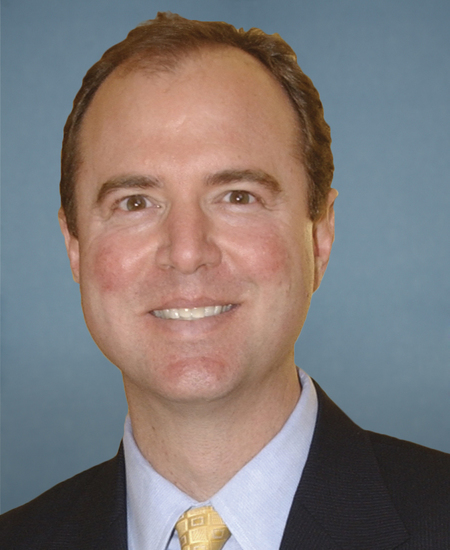
WATCH: Sen. Schiff Breaks Down Need for Federal Film Tax Incentive to Keep Production in America
Washington, D.C. – U.S. Senator Adam Schiff (D-Calif.) released a video highlighting his push to secure a bipartisan federal film tax incentive to drive more production in America while increasing job opportunities and economic development. The latest momentum for a federal film tax incentive in Congress follows President Donald Trump’s recent endorsement of its passage. In the video, Schiff breaks down how a federal film tax incentive would work and how it would increase America’s competitive edge in film and television production. Watch the video here Background: For years, Schiff has highlighted the need to increase film production in America and has continued to build bipartisan support in Congress for his federal film incentive proposal, which would promote American jobs and spur local economic growth by creating additional support for film and television production in the U.S., allowing us to compete with foreign incentives. This proposal would benefit every U.S. state and territory, doubling down on the investments of the 40 states that already have some form of film production incentive with a stackable federal credit. During his time in the California State Senate, Schiff helped lead efforts to increase production in California and protect local jobs. Schiff spearheaded efforts in Congress to extend California’s film tax credit, including in 2014 when he led 28 members of the California Democratic delegation in urging the leaders of the California State Senate and Assembly to reauthorize and enhance the tax credit. In 2024, Schiff sent a letter to the Bureau of Economic Analysis and the Bureau of Labor Statistics requesting detailed data on the impact of foreign production incentives on the domestic industry. In March 20, 2026, Senator Adam Schiff hosted a spotlight hearing in Burbank, California entitled, “Lights, Camera, Competition: Promoting American Film Production” to highlight the importance of bolstering American film production, and tackling the challenges facing the industry from generous tax incentives provided by other countries. Read the full transcript below: Sen. Schiff: So, what do the films “E.T.,” “The Hunger Games,” and “Pulp Fiction” have in common, besides the fact that they were big box office hits? What they have in common is they were all made in the United States of America. This is tragically becoming a rarity, particularly when you’re talking about film. We have a lot of runaway production of television, but it is most particularly an issue when it comes to movies. Anchor (In clip): Some of the most anticipated blockbusters of 2025 mostly shot overseas. In many cases, production budget cuts, multiple strikes domestically, and what some describe as a California tax incentive that’s no longer competitive, taking Hollywood elsewhere. Schiff: The movement of U.S. production of film and TV out of the country has huge consequences. Most particularly, we lose a lot of good-paying jobs. I feel this very keenly, being a resident of Burbank, California, where so much of the industry is concentrated. But we see high-paying jobs going to the UK and New Zealand, going to Canada and other places. This is a phenomenon called runaway production that we have seen for years, but it has been accelerating, and the result is the loss of many tens, if not hundreds, of thousands of jobs. I see these folks that are impacted by this all the time. I was walking through the streets of my hometown of Burbank the other day and was approached by someone who told me how they had worked in the industry for 25 years. They hadn’t had a union contract in three years. They’d never seen a more difficult time, and this is important to our economy. It’s also one of our most important cultural exports, our film and television. And the reason this is happening is that other countries many years ago started offering very generous tax incentives to try to lure this business away, because it has such a big impact on the rest of their economy, and these tax incentives have been successful. Now, some states like California have enacted their own tax credits to try to be competitive, but the U.S. government has not. (Clip from “Talladega Nights”) : Are you kidding me? Schiff: That may be about to change. This is something I’ve worked on for 20 or 25 years, but for the first time, it has truly bipartisan support. You’re seeing President Trump, who has experience in the entertainment industry, voice his support for a film and television tax credit. Trump (In clip) : They all want to be in Hollywood. They don’t want to lose Hollywood, and the unions want that. The unions are going to work along. I’ve done a lot of work in that the last week, and I think we have bipartisan support. I think we have tremendous Democrat — I understand Adam Schiff is totally in favor of it, and I’d like to get it done. It’s going to work very quickly. They want to make movies in Hollywood. They grew up wanting to be in Hollywood. Now you can’t make a movie in Hollywood. It doesn’t make sense. Schiff : You’re seeing others like Spencer Pratt and Jon Voight, the actor who is one of the president’s emissaries to Hollywood, also speaking out in favor of these tax credits. You have many Democrats like myself who’ve been pushing this for many, many, years. Laura Friedman, my colleague in the House, also a strong champion of this legislation, and we may finally have the opportunity to get this done. (Clip from “Elf”) : Oh my God! Schiff : I hosted a hearing on this issue earlier this year, and we had Noah Wyle, the star of “The Pitt” among many other shows and movies, testify about the impacts of the loss of production, and he used the illustration of “The Pitt” which is filmed in Los Angeles, to talk about what a positive impact that has on jobs and the local economy. Schiff (In clip): How was the decision to film here made, and how would a federal tax incentive on top of the state tax incentive, how would that affect the industry? Wyle (In clip) : You know, the one thing that Los Angeles has been able to offer is generational talent, homegrown here for over 100 years. This is the incubator of this industry, and the talent pool is immense. So the tax credit, augmented by a federal tax incentive, makes this competitive again and brings that work back to Los Angeles. Bottom line is that the estimated total impact of the first season of “The Pitt” contributed around 125 million dollars towards the state’s GDP during our production period. That is proof of concept. That is replicable, and it is vital to the strength of our industry and to our city to support these incentives. Schiff : He also talked about, frankly, how many jobs have been lost in the industry as a result of runaway production. Wyle (In clip) : Over the last six years, the aggregate effect of projects leaving the state in search of tax credits, the pandemic, and last year’s fires, has been a near cratering of our once thriving industry. We lost 42,000 film and TV jobs in LA County between 2022 and 2024. And as of last year, high-budget productions are down 43%. Admittedly, it’s really hard to shoot a TV show in Los Angeles, and it’s really expensive. Prohibitively so, unless you adopt an economic model that allows you to take full advantage of the California tax incentive to offset your gross costs. Schiff : Now there are more than one factor that have contributed to the exodus of some of the film and television industry out of California or out of the United States to other states. The high cost of production can be a factor, regulatory burdens can be a factor, but among the biggest factors are these tax incentives that have been offered by other countries. They’re extremely generous. We are not competitive, and as a result, we’ve been losing a lot of these jobs. So, how would a U.S. tax incentive work? How would it be competitive? (Clip from “Seinfeld”): So what’s the deal with politics? I don’t get it. Am I right, Pete? Schiff: Well, here’s basically how it would work. Under the proposal that I’ve written, in combination with many others, we would provide about a 20% tax credit for most film and television production. That is for the labor end of that production, so for the wages that these studios are paying employees, real people, to do this work. That tax credit could be augmented by five or ten percent, depending on whether the production is in a disaster zone or an economic zone, where there is a lack of good jobs and good employment, or when other circumstances, independent production are met. That could go up to a maximum of, a total of, 30 percent of federal tax credit. That is competitive with other countries. Other countries are still more generous than that in other respects. But here’s the thing: this would be stackable with tax credits offered by the state of California, for example. So, a production would enjoy the federal incentive as well as the state incentive. That makes us truly competitive with other countries, and that is great news for this vital American industry. So, what does this mean in practical terms? (Clip from “Austin Powers”) : Whoop-de-do! What does it all mean, Basil? Schiff : “Beetlejuice” was originally filmed in the United States in 1987, but its sequel in 2024 was filmed in the United Kingdom. “The Social Network,” filmed in 2010, was mostly filmed in Los Angeles and a few other locations, but its sequel, “The Social Reckoning” due out in October, was filmed mostly in Vancouver, Canada. “Spaceballs” originally filmed in the United States in Los Angeles, its sequel is shot in Australia. Even the new “Spider-Man” which is set in New York City and features New York taxicabs and New York landmarks was filmed in the United Kingdom, where they had to go to the expense of recreating scenes that looked like New York instead of filming in New York, and why? Because the UK has a very generous tax incentive that we don’t have. So, what about the argument that well, aren’t these tax incentives going to mean just giving more money to Tom Cruise, or these big Hollywood stars who have plenty of money to begin with? And the answer is no. These Hollywood stars are going to get paid wherever it’s filmed, whether it’s filmed in Canada or the United States, the UK. It doesn’t matter to their bottom line. What it does matter to is a lot of the set designers, and the caterers, and the local dry cleaners and all of the others who are working just to try to provide a good living for their family. I see these folks, I meet these folks, I talk to these folks all the time. They’re my neighbors, and they’ve had to spend increasing amounts of time out of the country, filming on location or simply out of work, because that work has left the United States. So those are the folks that I’m concerned about, that are really losing their jobs with the loss of this vital industry. We take great pride in this American cultural form, film and television, watched all around the world, and increasingly not shot in America. So I’m excited that this is one of the few bipartisan things that we can agree upon and have a hope of actually getting passed. In fact, this is what the President had to say on social media: “Congress should approve immediately a federal production incentive to create entertainment jobs in America. It can be done quickly, accurately, efficiently and importantly, will benefit all of America.” We’re going to look to the next few weeks to try to get this across the finish line. It is something that has been long in need, and something that we can accomplish together. ###
430c177a-910c-4cd1-88c4-4f59c91a2094Issued within 24 hours
Other senators' releases published in the day before or after this one.