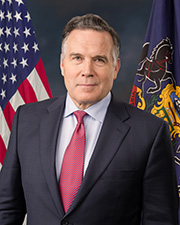
Master of Our Fate: America and the AI Revolution | Manhattan Institute
Remarks as prepared for delivery : Thank you, Reihan, and thank you to the Manhattan Institute for hosting me. From George Kelling and James Q. Wilson on broken-windows policing to Ed Glaeser’s insights in City Journal , this institution has helped answer the most pressing questions facing our country. It continues to do so under your great leadership. It is therefore fitting that we meet under the Manhattan Institute’s banner to discuss one of the most consequential questions of our time: how should America navigate the artificial intelligence revolution? The stakes could not be higher, and the answers are not simple. So please bear with me as I lay out a framework for meeting this moment. THE MOMENT Artificial intelligence may be the most transformative development in human history—bigger than the printing press, larger than the Industrial Revolution, more consequential than the race to the moon. It is rewiring how we work, how we learn, how we fight, and how we live together. I am often asked whether I’m optimistic or pessimistic about this change. I am neither. In fact, I am skeptical of both the doomers who predict mass unemployment—and sometimes seem to root against America—and the utopians who promise effortless abundance and resist any guardrails. The AI revolution is happening. Our task is to harness it for a safer, stronger, and more prosperous America. Whether we succeed depends on what we do now. To be clear, this moment demands humility. I spend more time on AI than many of my Senate colleagues, yet I still do not understand it as well as I should. No one in elected office is fully prepared. Humility must loom large in our minds. But humility does not mean inaction. America is in an existential race with Communist China for the technologies that will power the future. Even amid uncertainty, we must act with clarity, facts, and a sober recognition that we cannot afford to lose. THE PROMISES AND RISKS OF AI AI is already delivering remarkable benefits: advancing treatments for diseases like pancreatic cancer, making dangerous work safer, and offering a supercomputer to every small business owner and entrepreneur across America. It is also transforming warfare. Today’s battlefields look nothing like what I saw in the Gulf War, when I served in the 82nd Airborne. But the risks of the AI revolution are equally profound. I grew up in Bloomsburg, Pennsylvania, where the Magee carpet mill employed 2,000 people. It was the biggest employer in town, and many of my friends expected to work there, just as their parents did. Then globalization came. The mills slashed jobs. Storefronts emptied. And our town suffered. The people I grew up with know what it means to have their future rewritten by big forces beyond their control. Their fear of the AI revolution is rooted in memory. We cannot ignore them. We cannot shrug when workers lose their livelihoods. We cannot dismiss parents’ fears that chatbots will exploit their children. We cannot allow the wealthy to capture all the gains, corporations to steamroll communities, or Communist China to grow stronger on stolen American technology. These are real issues. They demand our urgent attention, and I would like to spend a few minutes on each. FIVE CONSIDERATIONS The first consideration is the American worker. Despite predictions of mass unemployment, early evidence suggests companies investing most heavily in AI are expanding their payrolls. Meanwhile, there is so much demand for skilled trades and workers to build energy and AI infrastructure that trade schools can’t keep up. Still, AI will eliminate jobs even as it creates others, just as the internet did. Without taking proactive measures, too many workers will be left behind. Expanding short-term Pell Grants via the Working Families Tax Cuts was a strong start, but Congress must go further. Employers must also equip workers to thrive alongside AI. We cannot repeat the mistakes of globalization. The second consideration is whether the unprecedented wealth creation of the AI revolution reaches the many or remains with the few. Capitalism is history’s greatest engine of prosperity. And few have benefited more—or will defend it more strongly—than I. But capitalism has a problem: the top 1 percent owns nearly a third of America’s wealth, up from less than a quarter in 1989, while the bottom half owns just 2.5 percent. We should expect AI to widen that divide by delivering extraordinary returns to those who own the models, compute, and equity. In response, Bernie Sanders proposes seizing half the industry’s equity. Such a move would cripple the engine of American prosperity. The better answer is to give more Americans an ownership stake in the AI revolution. Invest America accounts and school-choice tax credits offer promising models of voluntary investments in fellow Americans, but the scale of this challenge demands more. I challenge serious thinkers—including those at this institution—to help preserve capitalism by increasing access to its benefits. The third question is how we protect our children in the AI age. Technology that exploits a child’s vulnerability or identity has no place in the American marketplace. Congress and the Administration should establish national safeguards. We should bar social media for children under sixteen, and we should abolish AI models that groom, sexualize, deceive, or prey on minors. I am proud to support legislation that does just that. The fourth consideration is national security. If Communist China wins the AI race, it will gain military, economic, and technological supremacy. We must out-innovate China while denying it our most advanced tools. Congress should pass my Remote Access Security Act to block Chinese access to advanced chips through the cloud, and the Administration should continue cracking down on IP theft and industrial-scale distillation. At home, innovation—including open-source and open-weight development—must remain the default. President Trump deserves enormous credit for accelerating innovation through the AI Action Plan. Any regulatory review should be swift and light, except for models posing credible biological, cyber, or nuclear risks, which demand extraordinary scrutiny. The Administration should continue its good work with industry to establish clear standards, potentially through a FINRA-style framework encompassing frontier labs, open-source developers, startups, investors, workers, and users. The fifth and final consideration is whether we will build the infrastructure American AI leadership requires. I want to spend more time here because it is so contentious and so important—and because Pennsylvania is on the front lines. DATA CENTERS To win the AI race, we must build more compute. That means more energy to power data centers, more chips to fill them, and more workers to support the boom already underway. Building at that scale requires permitting reform. Today, $1.5 trillion in infrastructure investment is stuck in permitting limbo. My Unlock American Energy and Jobs Act would unleash that capital and create new construction and jobs. However, we must also reckon with the growing opposition to data centers on both sides of the aisle. Two weeks ago, Governor Kathy Hochul signed the nation’s first statewide moratorium on hyperscale data centers. Senator Sanders and Congresswoman Ocasio-Cortez have proposed a national one. More than 300 local bans have passed, and 74 percent of Pennsylvania voters say they would oppose building an AI data center in their community. I understand the concerns. No American should face higher power or water bills or have a hulking facility dropped into his backyard. But the choice is not between a moratorium and a runaway buildout that steamrolls communities. That false choice threatens America’s future. Our adversaries understand the stakes. Chinese and Russian outlets warn Americans that data centers will raise bills and drain water even as Beijing cuts power costs for its own AI facilities. When an adversary urges you to stop building what he is racing to build, pay attention. But in business, when things go wrong, you can’t only point fingers. You must look hard at what you’ve done. And, ladies and gentlemen, the industry has failed that test. Hyperscalers and developers have bought land through shell companies, arrived at hearings with lawyers instead of answers, and hidden basic details about power, water, and land use. Communities are saying no because industry has not earned their trust. There is a better path. To begin with, local officials should learn the risks and opportunities for themselves. A group of Pennsylvania township supervisors recently visited data centers in Loudoun County, Virginia. Most arrived skeptical; nearly all returned more open to them. Armed with the facts, communities and companies should strike a covenant built on four pillars. First, protect ratepayers. Developers should pay for their own power and transmission needs and stop seeking tax abatements and special treatment. The President’s Ratepayer Protection Pledge is a strong start. Second, protect land and water through efficient cooling, responsible siting, and strict compliance with permits. My bipartisan Liquid Cooling for AI Act would promote more energy- and water-efficient standards. Third, benefit the community. Hire locally. Buy American. Support local schools and businesses. Invest beyond tax payments. Fourth, be transparent. Put power, water, land, timelines, and tax treatment on the table early, in plain language, while communities can still shape the agreement. If you want me with you on the landing, include me on the takeoff. I have seen this work across Pennsylvania. At Homer City and Shippingport, new gas-fired power plants will power data centers and put a gigawatt each of new power on the grid. Elsewhere, developers such as Blackstone and QTS are engaging neighbors early and investing in infrastructure, workers, and long-term tax-base growth. Developers who honor this covenant will find willing partners across Pennsylvania and the nation. But local leaders who reflexively reject data centers risk forfeiting incredible opportunities for investment and job creation in their communities. FREEDOM’S FORGE These are the five big considerations before us today: our jobs, our wealth, our children, our national security, and our infrastructure. We don’t need a comprehensive rulebook for AI in order to address these questions. In fact, it would be a fool’s errand to write one. Too much is changing. Too much remains unknown. Too much is at stake. What we need, however, is a level of coordination between government and industry that has been sadly missing for some time. America has faced existential tests before. In the lead-up to World War II, the federal government set the objective, opened the order books, convened industry, and let builders build. The result was the greatest industrial mobilization in history, with Pennsylvania leading the Arsenal of Democracy. Government, industry, and workers formed Freedom’s Forge. We need a similar alliance today—uniting federal, state, and local government, business, capital, and labor behind a safer, more prosperous America and holding the builders and beneficiaries of that future accountable. We saw a glimpse of it last year at the Pennsylvania Energy and Innovation Summit, which Dina and I hosted in Pittsburgh. President Trump, Governor Shapiro, and leaders from energy, AI, finance, labor, and our universities announced $92 billion in new investment and tens of thousands of jobs. Our task is to build on examples like this. Embrace the future without leaving workers behind, protect our children without freezing innovation, broaden prosperity without abandoning capitalism, and beat China without sacrificing the liberties that distinguish us. This moment demands leadership and alignment across all levels of society. If we meet the AI revolution with humility, clarity, and faith in the American worker, it can usher in the next great American century. The future is up to us. We are the masters of our fate. Thank you.
4ba69582-8408-4def-b5f1-21148ef60a22Issued within 24 hours
Other senators' releases published in the day before or after this one.