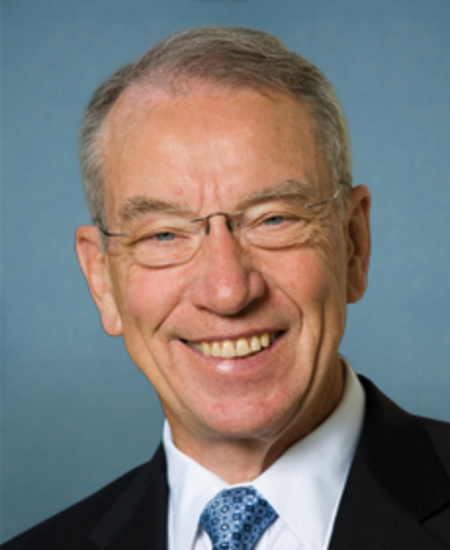
Q&A: Foreign Worker Visas Should Not Displace U.S. Workers
Q: Why did you write U.S. tech companies about their employment practices?
A:I chair the Senate Judiciary Committee, which has jurisdiction over federal immigration laws, including temporary visa programs that govern nonimmigrant visitors. A citizen of a foreign country who comes to the United States to study or obtain employment must obtain permission through one of themore than 20 nonimmigrant visasavailable, such as a business visitor, nanny, student, temporary agriculture worker and more. For years, I’ve ledbipartisan oversight of foreign visa programswith formerSen. Patrick Leahyof Vermont and Sen. Dick Durbin of Illinois to close loopholes and root out fraud and abuse.
The H-1B and L-1 programs provide a pathway for businesses to temporarily employ foreign professionals with specialized knowledge when there’s a shortage of qualified workers at home. It requires an employer to sponsor the visa holder; file required petitions with U.S. Citizenship and Immigration Services and the U.S. Department of Labor; and pay fees for the application process. Recently, the Trump administration proposed raising the fee to $100,000 per visa holder.
Congress created the H1-B program in 1990; it lasts for three years with a one-time renewal option. Over the years, some employers have exploited the system to cut out American workers for cheap foreign labor. Sen. Durbin and I in Septemberwrote lettersto 10 of the biggest companies in the country, includingAmazon, Apple andGoogle, to get an explanation why they continue to hire thousands of H1-B visa holders while recent data show U.S. college graduates with majors in science, technology, engineering and math (STEM) fields now face higher unemployment than the general population. For example, Amazon has laid off tens of thousands of employees in recent years and yet applied and received approval to hire more than 10 thousand foreign H1-B employees. This doesn’t pass the smell test. Homegrown talent must come first. Specifically, we want a full accounting about their recruitment practices; such as the number of H1-B workers they’ve hired, including salary and benefit disparities between visa holders and American workers; and whether U.S. workers were displaced when filing for thousands of visa petitions for foreign workers. Approximately 700,000 people are working in the United States on a H1-B visa, most are from India and China.
Q: How would your legislation close loopholes used to displace U.S. workers?
A:I’m rechargingbipartisan effortsto shed light on abuses and improve the H1-B visa system to stop the outsourcing of American jobs. A decade ago, I called outSouthern California Edisonfor laying off hundreds of American workers to be replaced by foreign H-1B workers. I also highlighted schemes byThe Walt Disney Companyin 2014 when American technology workers were told during the holiday season they would be let go, but would first need to train their foreign replacements. Unfortunately, such Mickey Mouse shenanigans have continued to exploit our foreign visa employment programs. That’s why Sen. Durbin and I recently reintroduced bipartisan legislation called theH-1B and L-1 Visa Reform Actto provide protections for American workers and visa holders. It would require greater transparency in the recruitment process of foreign workers and beef up enforcement tools for the Department of Labor (DOL) to ensure the program is operating as Congress intended. Specifically, our bill would implement new requirements on employers with regard to wages, recruitment and sponsorship of H-1B and L-1 workers; require employers seeking to hire H-1B employees to post these jobs on a searchable DOL website; authorize DOL to place a fee on labor condition applications; reform visa issuance to prioritize workers with higher levels of education in STEM and amend “specialty occupation” to require a bachelor’s degree or higher; put new time limits on L-1 nonimmigrant visas and require the Department of State to verify foreign affiliates and increase penalties for wage violations, including fines or debarment of employers found in noncompliance. The bottom line is simple. American workers ought to come first.
531b0252-9cbb-4a9f-892b-1c8d43f40930Issued within 24 hours
Other senators' releases published in the day before or after this one.