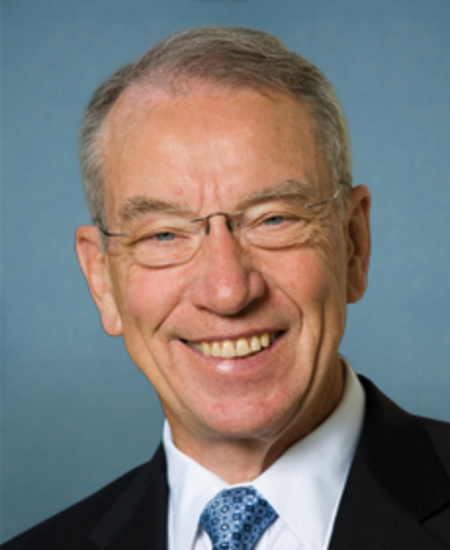
Grassley Highlights the Importance of His Accelerating Kids Access to Care Law
Prepared Floor Remarks by Senator Chuck Grassley of Iowa Senate President Pro Tempore “The Accelerating Kids Access to Care Act Becomes Law” Wednesday, February 25, 2026 VIDEO On February 3, President Trump signed into law the fiscal year 2026 funding package that included an important priority of mine, the Accelerating Kids’ Access to Care . This law will simplify the process so kids with complex medical needs can get the specialized health care they need in a timely manner. I would like to spend a few minutes explaining the importance of this new law and how we got here. Kids with complex medical needs often face red tape, delays and frustrations when getting their specialized medical care. The federal government defines kids with complex medical needs as having a life-limiting illness, a rare pediatric disease or one or more chronic conditions that impact multiple organ systems and reduces cognitive or physical abilities. This can be a kid with cancer, cystic fibrosis or congenital heart disease. These kids, on average, see five to six specialists and up to as many as 20 to 30 allied health professionals . Parents are often overwhelmed at the scope of that care and how to navigate the system to get that care. The specialized medical care for a kid with complex medical needs tends to come from only a few providers and often out-of-state at a pediatric hospital. This requires coordination with in state and out-of-state providers and state Medicaid officials to allow this care to happen. The process to get care is difficult and full of red tape, delaying care these kids desperately need, and in some cases, not receiving care at all. To solve this problem, in 2018, I introduced the Accelerating Kids’ Access to Care bill. Our aim was simplification. This law will give states the ability to use a streamlined screening and enrollment process for out-of-state specialized pediatric care providers that need to enroll in a state’s Medicaid program. We do this while also retaining safeguards to protect program integrity. When I started working on this law in 2018 during the 115th Congress, we had eight bipartisan sponsors. In this 119th Congress, it garnered 46 bipartisan sponsors and became one of the most cosponsored Medicaid bills before the Finance Committee. Over the past few years, we built support from well over 200 organizations dedicated to pediatric care. I also worked with my colleagues, including those on the Finance Committee. I want to thank the Chairman of the Finance Committee for his partnership in getting this law passed. The passage of the Accelerating Kids’ Access to Care is a win for kids with complex medical needs and their families. It’s a win for kids like Charlie , a brain tumor survivor, who spoke before the Finance Committee in 2023 about the importance of this bill. It’s a win for kids like three-year-old Edwens from Perry, Iowa, whose family travels out of state, so he can receive pediatric gene therapy at the M. Health Fairview Hospital in Minnesota. Only a few medical centers provide this kind of care in the country for his rare disease. There are many other kids whose lives will improve because of this law. Another person I think of when I talk about this law is the late Katie Beckett . Katie was from Cedar Rapids, Iowa. She was born in 1978, and at five months, she contracted a brain infection that required a ventilator to breathe. After years in the hospital, Katie was unable to leave because Medicaid rules didn’t allow her to receive care outside the hospital, even though it was possible for her to get care at home, and it was more cost-effective . In the early 1980s, President Reagan heard about Katie’s story, and he removed red tape for Katie through a Medicaid waiver. Since then, Katie Beckett waivers have resulted in more than a more than a half million disabled kids being able to receive care in their homes rather than being forced into hospitals and institutions. In my time in the Senate, we’ve seen medical advancements for kids with complex medical needs, and Congress has responded by giving these kids and their families the proper medical resources. One of those resources was the Family Opportunity law that President Bush signed 20 years ago this month. That law did several good things. First, it enabled middle-income families who have kids with disabilities to buy into Medicaid. It has helped families get the health care they need for their kids with disabilities , without going into poverty. It was pro-work, pro-family and pro-taxpayer. This law also established the Family-to-Family Health Information Centers . Today, these centers in each state are helping families and their kids navigate the complex system of services and supports. This is the kind of empowerment Washington ought to promote: public policy that illuminates opportunities instead of keeping people in the dark. More recently, in 2019, Congress passed my Advancing Care for Exceptional Kids law, or ACE Kids. ACE Kids better aligns Medicaid rules and payment to incentivize coordination of care. It does this by establishing a pediatric health home for kids with complex medical conditions. Kids with complex medical conditions often see multiple doctors and dozens of health professionals . That’s a lot of care coordination that often doesn’t happen or it’s left to parents to figure out. ACE Kids fixes this and ensures care coordination happens. While I’m sure more work will need to be done, I want to recognize the hard work that went into the passage of the Accelerating Kids’ Access to Care law and the importance of it. It’s another step towards supporting the dignity of exceptional kids. -30-
5e687995-9d24-4423-9a44-84b04322addeIssued within 24 hours
Other senators' releases published in the day before or after this one.