Opening statement of Chairman Smith at Nigeria hearingOne Year Later: Assessing Nigeria’s Efforts to Protect Christians and Secure the Middle Belt
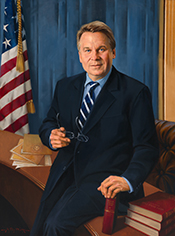
The following are excerpts of Chairman Chris Smith’s (R-NJ) opening statement at the House Foreign Affairs Africa Subcommittee’s November 12 th hearing—his fourteenth hearing chaired on the religious persecution of Christians by radical Islamist groups in Nigeria—entitled “One Year Later: Assessing Nigeria’s Efforts to Protect Christians and Secure the Middle Belt”: On October 31 st of last year, President Trump said : “Christianity is facing an existential threat in Nigeria. Thousands of Christians are being killed. Radical Islamists are responsible for this mass slaughter. I am hereby making Nigeria a ‘COUNTRY OF PARTICULAR CONCERN’” (pursuant to the International Religious Freedom Act of 1998 (PL 105-292) and the Frank R. Wolf International Religious Freedom Act of 2016 (PL 114-281)). The CPC designation was a wakeup call for Nigeria and an urgent call to action to protect religious believers—mostly Christians—who have been victims of brutal attacks by ethnic Fulani militia and other terrorist groups, like Boko Haram and ISIS West Africia. It has been just over one year since this designation, and almost exactly one year since this Subcommittee held a hearing on this topic—where I said that the designation is only the first step. One of our witnesses today, Nina Shea, will testify: “A year later, the atrocities continue to mount, and Nigeria maintains its ranking as the world’s deadliest place for Christians for faith-related reasons, accounting for 72 percent of such killings worldwide, according to Open Doors… The greatest threat to Nigeria’s Christians in recent years has been posed by bands of Fulani Muslim militants in the Middle Belt states particularly Benue, Plateau, Kaduna, and Taraba. In a consistent pattern evidencing a degree of organization, coordination, and funding support, Fulani militias invade rural Christian villages and farming areas and murder, maim, rape, and kidnap for ransom the defenseless residents and their church leaders. Thousands of Christians have been killed and taken hostage for ransom in these unprovoked attacks, which continue to the present. This violence has forced over a million survivors of such attacks from their lands and homes, and they are now destitute and hopeless, indefinitely consigned to camps for displaced persons. Nigeria’s government has failed to protect the Middle Belt Christians from Fulani terror.” For years, my congressional colleagues and I warned that the violence was escalating, that Fulani perpetrators were operating with impunity, and that the Nigerian government's failure to protect its citizens demanded a sustained response, with serious encouragement from the United States. Today, just over one year later, we confront an even more troubling reality. The violence has not ended. Christian communities continue to face killings, abductions, attacks on churches, and the destruction of their homes and livelihoods. The purpose of today’s hearing is not merely to revisit the benign admonishment of the United States to a friend and ally—friends don’t let friends commit human rights abuses. It is to examine the Nigerian government’s continued failure to protect vulnerable communities and hold those responsible accountable; assess how the United States has engaged with Nigeria since its CPC redesignation; and determine what additional measures are needed to end the violence and prevent further atrocities against Christian communities in the Middle Belt and throughout Nigeria. I have worked to bring sustained congressional attention to the persecution of Christians in Nigeria for decades and have chaired over a dozen hearings focused on Nigeria, undertaken fact-finding trips, and met face-to-face with survivors of horrific violence, including victims of Boko Haram attacks in Jos in 2013. Fourteen years ago— in 2012—I chaired a hearing focusing on the slaughter of Christians by Boko Haram, and the Assistant Secretary of State for African Affairs Johnnie Carson testified “that the phenomena of Boko Haram is one of discrediting the Central Government in power for its failure to deliver services to people.” Are you kidding? I responded by asking why Boko Haram abducts and rapes Christian girls and uses force and coercion—even death—to convert Christians to Islam? Where are they getting their weapons? Are the IEDs coming from Iran? Not only should Nigeria be designated a Country of Particular Concern (CPC) for failing to protect believers, but why isn’t Boko Haram designated a Foreign Terrorist Organization (FTO)? After three years of appealing to President Obama and the State Department to designate Boko Haram a FTO, on the day of markup on my legislation—the Boko Haram Terrorist Designation Act of 2013 (HR 3209)—to put Congress on record demanding FTO designation, the Administration designated Boko Haram a Foreign Terrorist Organization. For too long, the Nigerian Government and the world have looked away—a culture of denial—as radical Fulani militants, Boko Haram and ISIS/West Africa have waged a relentless campaign of terror, murder, and displacement across Nigeria. I—and many others— have consistently advocated for stronger diplomatic pressure, conditioning U.S. assistance on measurable progress, targeted sanctions against perpetrators, and direct humanitarian support for communities devastated and displaced by this violence. I commend the State Department’s continued action, including the high-level visits to Nigeria from Undersecretary Hooker and Assistant Secretary Garcia and the recent U.S.-Nigeria Joint Working Group meetings. We look forward to hearing more about how these engagements are translating into observable action by the Nigerian government. This Congress, the committee was tapped by the White House, in coordination with the Committee on Appropriations, to draft a report on the steps needed to capitalize on the CPC designation. We turned this report into legislation through the Nigeria Religious Freedom and Accountability Act of 2026 (HR 7457). Our objective has remained unchanged: to end the persecution, ensure accountability, and protect the fundamental right of every Nigerian to practice their faith without violence or fear. We cannot allow this opportunity to fall flat once more. The Nigerian government has a critical responsibility to protect its citizens, and I urge the State Department to leverage all diplomatic tools to bring action and accountability. One year ago, we sounded the alarm. Today, we must ensure that alarm is answered with action. Today, for our first panel, we have Assistant Secretary of State for the Bureau of African Affairs Frank Garcia and Assistant Secretary of State for the Bureau of Democracy, Human Rights, and Labor Riley Barnes. Thank you both for being here, and I look forward to hearing about the steps your bureaus have taken over the past year, the obstacles that remain, and what more must be done to end this horrific violence. ###
7e7e02b6-8607-4a34-aada-d08815e70198Issued within 24 hours
Other senators' releases published in the day before or after this one.