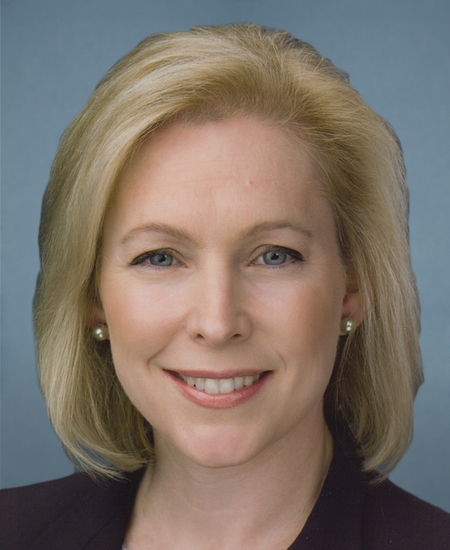
Gillibrand, Colleagues Introduce Legislation To Permanently Make Federal Services Language Accessible
Today, U.S. Senator Kirsten Gillibrand (D-NY) joined a bicameral group of colleagues to introduce the Language Access for All Act , legislation to codify language access requirements for federal agencies and protect language access for the 25 million individuals in the United States with limited English proficiency. The legislation would prioritize customer service governance by reducing barriers to federal services and making sure federal agencies are equipped to meet diverse language needs. “Millions of New Yorkers rely on federal services to feed their children, obtain necessary medical care, or run their businesses,” said Senator Gillibrand. “As the Trump administration makes accessing these services more difficult for non-English speakers, the Language Access for All Act will ensure that every American can get the help they need, regardless of language barriers. I will continue fighting to hold our federal agencies accountable so that no New Yorker is shut out of the services they’re entitled to.” The Language Access for All Act is being introduced as services come under threat from the Trump Administration. In March 2025, President Trump signed Executive Order (EO) 14224 that declared English as the official language of the United States and revoked EO 13166, a 25-year-old mandate that required agencies to provide critical language access to individuals with limited English proficiency (LEP). The Trump administration’s Department of Justice issued new guidance that minimizes multilingual services and redirects resources towards English language assimilation. These policy changes threaten language access for the over 25 million people in the United States—eight percent of the U.S. population—with limited English proficiency. About 30% of New Yorkers, or 5.8 million people, speak a language other than English at home. Of them, around 2.5 million have LEP. Nearly 40% of Spanish speakers, who make up the majority of those who speak another language both in the United States and in New York State, report speaking English “less than very well” in the most recent U.S. Census. The Language Access for All Act of 2026 would modernize and strengthen the federal government’s language access services by formalizing EO 13166 and establishing a coordinated, accountable framework to ensure meaningful access to government services for individuals with limited English proficiency. Specifically, the legislation would: Requires federal agencies to ensure that individuals with LEP can meaningfully access the federally conducted programs and activities of the agency, including through translation and interpretation. Creates a public complaint system to track complaints regarding barriers to meaningful access at agencies. Requires agencies to develop and maintain language access plans consistent with EO 13166, with public notice and comment, and to submit plans to Congress and publish them on LEP.gov. Establishes language access technical standards that allow individuals with LEP to access agency content. This applies to all agency communications, including AI and automated language assistance services. Ensures AI-assisted language services do not replace qualified translators and interpreters, comply with federal privacy requirements, and are continuously tested for bias, discrimination, and errors. Creates an interagency language access working group to provide guidance, coordination, and technical assistance. Requires each agency to designate a language access coordinator to lead implementation and serve as a point of contact. Senator Gillibrand has long advocated for improving accessibility in language translation for non-native English speakers. In February 2023, she co-signed a letter to the Federal Communications Commission with Representative Grace Meng (D-NY-06) urging for more languages to be included in their emergency alerts, ensuring the safety of all regardless of language barriers. She also championed a $2 million investment in March 2023 from the Bipartisan Infrastructure Law to expand transportation services for commuters with limited English proficiency. In addition to Gillibrand, the legislation is co-sponsored by Senators Andy Kim (D-NJ) and Mazie Hirono (D-HI) and was introduced in January 2026 in the House of Representatives by Representatives Judy Chu (D-CA-28), Grace Meng (D-NY-06), Juan Vargas (D-CA-52), and Dan Goldman (D-NY-10). Read the full text of the Language Access for All Act here . ###
d1a5f6d1-8e9a-4b86-8e09-867d8196d4ebIssued within 24 hours
Other senators' releases published in the day before or after this one.