Jayapal Introduces Legislative Framework Establishing National Charter System to Rein in AI
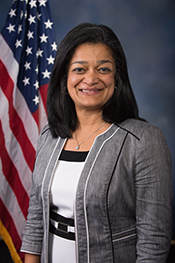
10.01.2026 | News Jayapal Introduces Legislative Framework Establishing National Charter System to Rein in AI SEATTLE, W.A. — U.S. Representative Pramila Jayapal (WA-07) is introducing a new policy framework that reins in artificial intelligence (AI) by requiring every AI company to hold a federal charter to do business in the U.S. The AI charter is modeled after existing regulatory frameworks, combining the round-the-clock federal oversight, strict safety mandates, and structural separation built into national bank charters with the rigorous pre-release federal testing required for nuclear materials and dangerous weapons. The charter would ensure that the public’s interests come first and that the government has broad authority to hold AI companies accountable before they create harm rather than addressing abuses after the fact. AI companies that don’t agree, don’t comply, or put the public in danger get shut down. “The crux of this bill is simple: if you want to be an AI company in this country, you have to obtain a public charter that has a broad set of terms and conditions to operate and ensure public benefit without the harms,” said Jayapal . “For too long, we’ve allowed a few Big Tech companies to dominate the market. They have used mass surveillance to steal private information, labor, and creative work, building trillion-dollar empires on our tracked personal lives. AI corporations and Big Tech are now following that same playbook. My National AI Charter Act framework gets at the root of the problem by disrupting the way the AI market is structured to give a very few companies all the power over our data and what happens with it and instead establishes clear rules of operation for these AI companies and prioritizes safety over profits.” To date, traditional Big Tech policies have tried to patch up problems around the edges after harm is done, treating data privacy, children’s safety, worker rights, market concentration, and all the rest as separate issues. That approach hides the full scope, reach, and systemic impact of Big Tech’s surveillance monopolies. The fragmented response has allowed their lobbyists to divide the broad coalition of their victims, narrow fights to single-issue bills that they stall, make the case for self-regulation, and ignore the root profit drivers incentivizing their bad behavior. The National AI Charter Act takes a fundamentally different approach by addressing the full scope of AI harms comprehensively upfront. The charter would be required to operate AI and its terms and conditions would be mandatory. At its core, the charter framework recognizes that AI risks are connected and driven by underlying market structures, surveillance business models, and profit motives. AI companies would be banned from building empires, releasing risky models, stealing through surveillance, exploiting workers, or causing harm. Gating market access to companies that comply with these requirements would break Big Tech’s grip on AI and protect the public from dangerous AI models. The framework’s new legal authorities to hold AI companies accountable would build on those that already apply. They would not preempt or replace federal, state, and local laws, nor would they prevent or impede law enforcement agencies from enforcing those laws against AI companies or their executives. Instead, they would strengthen the hand of prosecutors and plaintiffs by proactively confirming the many ways these laws apply to AI, rather than leaving it to judges to interpret case by case. Most importantly, making this illegal conduct a charter violation would create a powerful additional enforcement tool with serious, mandatory consequences. The National AI Charter Act framework’s comprehensive approach would bolster existing law enforcement by: Taking power back from billionaires and putting the public and workers first: The handful of billionaires and tech giants that control AI’s future are locked in a dangerous race to the bottom. The framework separates AI companies from Big Tech monopolies and bans their predatory commercial surveillance so that AI isn’t baked into the core Internet platforms everyone uses or trained with data harvested by tracking everything people do online. It also claws back Big Tech’s ill-gotten gains from their monopoly data to fund direct payouts to all Americans. Preventing harm up front instead of chasing it afterward: AI harms can spread too fast for after-the-fact enforcement to stop them, and fines don’t remedy the damage or truly deter it from happening again. The framework’s upfront charter requirements are not just rules to follow; they are a mandatory price of entry into the AI industry and the condition for remaining in it. Companies must continuously comply or get shut down. Drawing bright lines on the full range of AI dangers: AI’s dangerous capabilities cannot be prevented with technical rules that quickly become obsolete; they have to be comprehensively banned outright. Under the framework, AI systems capable of going rogue, creating catastrophic hazards, replacing skilled work, exploiting children, or causing other serious public harms are outlawed and cannot be released. Putting the government in charge of safety at every stage: AI companies have admitted the risks of their own systems while still insisting they should police themselves. The framework replaces the AI industry’s failed self-regulation with round-the-clock federal oversight, testing in government facilities and approval to release, adversarial stress tests, and a government-controlled kill switch. Imposing strict liability on AI companies and executives: As long as the price of causing harm is likely to cost less than the potential profits, AI companies will keep taking reckless risks. The framework reverses these incentives by holding AI companies and their executives strictly liable for lawbreaking, with loss of charter and criminal penalties for the most serious violations. “At the end of the day, the American people are feeling a loss of control, of their personal data, of their jobs, of their ability to even know what they see online is real,” Jayapal added. “This legislation would restore a level of control and ensure that every search made online isn’t tracked, every family photo posted isn’t training an AI model, and every piece of our lives isn’t monetized by corporations.” A wide range of experts have weighed in on the need for a comprehensive approach: “The public has paid an extraordinary price for big tech’s self-regulation. Representative Jayapal’s framework learns from those mistakes. For generations we have required banks, drug makers, and nuclear operators to meet public terms before they do business, and AI companies should be no different,” said Lina Khan, Director, Center for Law and the Economy, and former Chair of the Federal Trade Commission. “This legislative framework meaningfully advances the ball to establish a comprehensive set of reforms to address the potential for societal harms from AI,” said Jonathan Kanter, former Assistant Attorney General of the Department of Justice’s Antitrust Division. “We really need a framework like this to start getting to the big question of how Americans want to regulate AI,” said Tim Wu, Julius Silver Professor of Law, Science and Technology, Columbia Law School. “Innovation and safety are not opposing concepts; they’re two sides of the same coin—which is why regulation is vitally important. AI is rapidly transforming our classrooms, workplaces, and economy, but Big Tech must be held accountable for their business models, just like every other industry in the country. If these companies want to win the trust of the American people, they must respect the rules of the road. Representative Jayapal’s framework does exactly that by establishing preemptive guardrails that compel AI firms to serve the public interest, not just the narrow interests of shareholders,” said Randi Weingarten, President, American Federation of Teachers. “The comprehensive approach being pioneered by Representative Jayapal’s National AI Charter Act gets to the root of the extreme harms of unregulated and out-of-control AI. The mandatory requirement to be chartered and operate only under strict guardrails and associated liability will hold companies accountable and ensure that protecting the public is considered first as tech is created. Public Citizen applauds this move to fight concentration and to defend children, workers, and the general public from pervasive harm,” said Lisa Gilbert, Co-President, Public Citizen. “I’m thrilled that Representative Jayapal is taking such a leading role in addressing the enormous societal risks posed by increasingly powerful and uncontrollable AI systems. Efforts like the National AI Charter Act to address the full scope of AI harms are more important today than ever before,” said Anthony Aguire, President and CEO, Future of Life Institute. “Big Tech companies have continually pulled the rug out from under families, workers, and small businesses to build powerful and unaccountable Big Tech monopolies that dictate to us how we should live our own lives. Enough is enough. We are proud to support the National AI Charter Act because it will establish desperately-needed rules of the road, punish AI companies that release dangerous products, and create the clear public benefit that the American people are calling for,” said Sacha Haworth, Executive Director, Tech Oversight Project. “The same billionaires who walked away with huge tax breaks last year are now racing to take over AI. For years they’ve lobbied every attempt at regulation to death. Representative Jayapal’s plan goes after the source of their power: their monopolies, their surveillance, and their stolen data. It’s the first plan big enough to match the problem, and it puts families back in charge,” said Kristen Crowell, Executive Director, Families Over Billionaires. “This is not a time for half measures. We are facing serious challenges, if not crises, on every possible front in this country, and we need leaders who are putting forward proposals that meet the moment. This framework puts humans at the center of the debate about AI and regulation and puts power back in the hands of people over the technology that shapes their lives,” said Shaunna Thomas, Executive Director, Guardrails Action. “We have a long history of governing banks, utilities, critical infrastructure. In all of these, we have leverage over market interests, and the ability to gate access to the market on the condition that the public interest is protected. We need commensurate leverage over large AI companies, and this is the right lineage to draw upon,” said Amba Kak, Co-Executive Director, AI Now. “Rep. Jayapal is right: if you want to run an AI company in this country, you should have to accept the public’s terms. For too long, Big Tech has acted first and answered for the harm later, if ever. A national charter would change that. We also support her proposal to structurally separate the AI stack. And we urge Congress to consider building on the authorities existing agencies already have. There’s more work ahead to make sure this framework can stand up to Big Tech’s lawyers and lobbyists, and we look forward to doing it with her,” said Nidhi Hegde, Executive Director, American Economic Liberties Project. “We are in the midst of a reckoning on AI as working families and communities across the country are rightfully standing up and sounding the alarm on the growing harms that this technology is posing on our day to day lives. For too long, Big Tech CEOs have been able to divide and distract policymakers while they use the public’s own data to raise prices, push millions of working people into debt, and rake in record profits. It is long past time for policymakers to break Big Tech’s grip on AI and we applaud Congresswoman Jayapal for unveiling the National AI Charter Act Framework which marks a critical first step in reining in Big Tech and protecting families,” said Mike Pierce, Executive Director, Protect Borrowers. “It’s unacceptable that Big Tech continues to abuse our data, turbocharge scams, and act with impunity. This framework reflects the interconnectedness of the harms that AI companies are already causing and the necessity of strong, robust enforcement mechanisms that can provide meaningful protections for consumers,” said Susan Weinstock, CEO, Consumer Federation of America. “We welcome Congresswoman Pramila Jayapal’s leadership to address AI’s real harms. We’re encouraged to see a comprehensive, structural approach with sharp guardrails and bright lines. For too long, a handful of tech giants have written the rules and remade society to suit themselves. It’s high time the public wrote the future instead,” said Stacy Mitchell, Co-Executive Director, Institute for Local Self-Reliance. “For far too long, the tech oligarchs and those whom they directly or indirectly fund have sought to normalize how the modern technology sector prefers to operate. Congresswoman Jayapal rightly recognizes as illegitimate those practices that tech oligarchs have long celebrated as creative and adventurous even as they violate longstanding laws and norms. In a democracy, it is publicly elected figures who are responsible for leading the future, not the oligarchic class,” said Jeff Hauser, Executive Director, Revolving Door Project. “AI poses very real risks to safety, privacy, workers, competition, and more. This range of harms requires a comprehensive, structural policy response. In many critical industries, we mandate charters to do business, impose bright-line bans on problematic conduct, subject firms to independent inspection, and use other common-sense tools to reduce risks. The U.S. needs to deploy these same tools to keep powerful firms accountable and to put the public’s interest first in AI,” said Asad Ramzanali, Director of AI & Technology Policy, Vanderbilt Policy Accelerator. “This is a smart framework that recognizes how powerful AI companies are already putting the public at risk, exploiting data, and consolidating control over critical technologies and markets. Adopting the charter model offers a sweeping yet adaptable way to welcome innovation while imposing enforceable obligations for safety and fair competition, placing necessary checks on private power, and ensuring corporations develop AI in the public interest,” said Courtney Radsch, Director of the Center for Media and Digital Governance, Open Markets Institute “AI companies and their executives are threatening working people’s health, safety, and pocketbooks in their reckless race for profits. Congresswoman Jayapal’s National AI Charter framework would take on these threats in a comprehensive way by putting the public interest first and making the existence of AI firms contingent on their compliance with strong safety and privacy requirements alongside worker, consumer, and investor protections,” said Maya Jenkins, Senior Policy Analyst, Americans for Financial Reform. An outline of the framework can be found here . The framework was developed, in part, following a hearing that Jayapal hosted on the dangers of surveillance AI conducted by Big Tech. Issues: Environment , Foreign Affairs & National Security , Health Care , Jobs, Labor, & the Economy , Public Safety & Criminal Justice , Science, Technology, & Antitrust Share: Facebook Twitter Mail
eb4498e0-21c8-4960-87b7-1ba08ac518beIssued within 24 hours
Other senators' releases published in the day before or after this one.