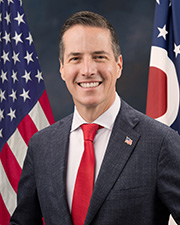
Moreno Leads Ohio Congressional Delegation Push to Bring Space Academy to Ohio
WASHINGTON – Senator Bernie Moreno (R-Ohio) led the Ohio Congressional delegation in a letter to President Trump and NASA Administrator Jared Isaacman making the case that Wright-Patterson Air Force Base is the only location for the United States Space Academy. “Ohio will usher in a new Golden Age of Space Exploration,” the lawmakers wrote. “As President, you created the United States Space Force, and the United States Space Academy, at Wright Field, can be established ahead of schedule, under budget, on the ground where American flight began. It will be the institution that transforms the industrial heartland back to its former glory once known as the ‘Iron Belt’ into the nation’s ‘Space Belt’ and open a new Golden Age of American exploration.” Read the full text of the letter HERE or below. November 20, 2026 The President of the United States of America The White House 1600 Pennsylvania Avenue NW Washington, DC 20500 The Honorable Jared Isaacman Administrator, National Aeronautics and Space Administration Chair, Presidential Commission on the United States Space Academy 300 E Street SW Washington, DC 20546 Dear President Donald J. Trump, Administrator Isaacman, and Members of the Commission: We write as the United States Senators and Members of Congress from the State of Ohio, Republicans and Democrats alike, united with one voice. Mr. President, pursuant to your Executive Order 14423, Establishing the United States Space Academy, the State of Ohio has submitted its proposal, and we write to tell you plainly what it offers: the Academy should be founded at Wright-Patterson Air Force Base Area B in Dayton, Ohio, known as “Wright Field,” on the very ground where the Wright brothers taught the world to fly. No other site in America can open its doors as quickly or at a lower cost, offer access to a more technologically advanced academic institution, or claim ground more hallowed in aviation history and more worthy of the mission you have set. The new Space Race is real, and the Space Academy’s timeline demands a campus that already exists. Beijing has set its date: Chinese taikonauts on the Moon by 2030, with the trained personnel, spacecraft, and launch complexes to keep them there. The decisive question of the space century is not who lifts off first, but who gets to the lunar surface most frequently and who educates the officers who will live, work, and command beyond Earth. America cannot afford to waste time and billions of dollars building a campus while the CCP races toward its deadline. Ohio can answer the call now. With nearly $40 billion already invested in facilities across a twenty-five-square- mile operational footprint spread across the state and an accredited campus built for twenty thousand students standing beside Wright-Patterson, the Academy can welcome its inaugural class as early as the fall of 2027, meet the four-thousand-cadet target by 2031, and could double its requested capacity to eight thousand if needed. In Ohio, the Academy does not need to be built. It is ready to open now. Ohio is already home to the “original” Space Academy and is the only place where the Academy can open immediately and at full capacity. What West Point is to the Army and Annapolis is to the Navy, Wright Field should be to the United States Space Force. The Air Force Institute of Technology has taught on this ground since 1928. It is the original Space Academy, and thirteen astronauts have received degrees from this institution since 1959. Wright State University, the only civilian university in America directly adjacent to an active military installation, stands ready to serve as the accredited undergraduate partner from the first day. Wright Field is the greatest brand in air and space. Ohio is home to the Mount Rushmore of Aviation and Innovation. In 1959, the Mercury Seven were selected through testing at Wright-Patterson, and to this day, America’s astronauts come to its 711th Human Performance Wing, home to the Department of War’s only human-rated centrifuge, for evaluation and training. On this ground, the Wright brothers opened America’s first flying school and trained 119 of the nation’s first pilots, including a young Hap Arnold. Twenty-five astronauts have called Ohio home. Thomas Edison, who brought electric light to the world and pioneered the modern research laboratory; John Glenn, the first American to orbit the Earth; and Neil Armstrong, the first man to walk on the Moon, left a legacy of American innovation and exploration unmatched by any other state. It’s in Ohio’s DNA. Houston has trained America’s crews for their missions with distinction for sixty years, and it should continue doing exactly that. But before an astronaut is trained for a mission, an officer must be forged, and the ground that selected and prepared America’s first astronauts is the ground on which to forge the next hundred thousand. The scale is already federal, already operating, and already paid for. Wright-Patterson is the Department of the Air Force’s largest single-site installation. The Air Force Research Laboratory, headquartered there, executes billions of dollars in funding each year, representing the largest concentration of space technology on any American base. The National Space Intelligence Center watches every object in orbit from Wright-Patterson, and the School of Aerospace Medicine trains the flight surgeons of American spaceflight. More than 640 aerospace and defense companies operate in Ohio. To the northeast, NASA’s Glenn Research Center leads the agency’s work in nuclear propulsion, technology intended to reduce the voyage to Mars from six months to three. NASA’s Armstrong Test Facility houses the largest space-environment chamber on Earth, where the Orion crew vehicle was qualified for flight. These facilities would educate cadets through experiential residencies. Launch and operations are only the first few minutes of spaceflight. Ohio answers the call for the rest of the mission and the journey toward becoming a multiplanetary species. Florida’s Kennedy Space Center launches spacecraft, Houston’s Johnson Space Center manages mission control, and Louisiana’s factories support the nation’s space program. All should remain precisely where they are. They are national treasures. But they stand, every one of them, along the same few hundred miles of storm-swept coastline, in the path of the same hurricanes and within the same threat rings an adversary has already drawn. The officer and warfighter pipeline is the one asset that reinforces every other, and the rule American planners have followed since the Second World War is simple: what the nation cannot afford to lose, it does not concentrate in one place. The Academy belongs a thousand miles inland, protected by the breadth of the continent, at Wright Field. The coast also represents only part of the mission. Launch and flight operations are the opening minutes of spaceflight, and America has largely mastered them. The Academy should exist for everything that follows: feeding crews on the Moon, keeping humans safe through years in deep space, defending our low-Earth orbit constellations, and building with materials from the lunar and Martian surfaces. Those disciplines are already Ohio’s. The Ohio State University leads the nation in agricultural research, NASA established a civilian residency in aerospace medicine at Wright State in 1978, Ohio University trains students in mining, the University of Toledo offers longstanding research expertise in deep-space observational astrophysics and spacecraft power, and America Makes in Youngstown leads the nation in additive manufacturing. Wright Field already rivals the U.S. service academies in tourism and, with the Academy located in Ohio, has the potential to attract two times as many visitors as any other service academy. Dayton sits within a day’s drive of sixty percent of the American people, and the grounds already draw nearly a million visitors annually, on par with West Point. Place the Academy at Wright Field, and it becomes a staple of American education: the class trip every school within five hundred miles takes, the campus tens of millions of families can reach on a tank of gas. An academy on a distant coast is a destination; an academy at Wright Field becomes part of the fabric of American life. And on day one, the Academy’s Guardians take the field. Ohio’s proposal delivers a complete Division I athletic infrastructure: competition and training facilities on campus, a twelve-thousand-seat basketball arena, and a 65,000-seat NFL football stadium just 45 minutes down the road for the games the whole nation will watch. Army-Navy proves that athletics is how America meets its academies, and Air Force versus Space Force will become the next great American service academy rivalry. With the Air Force Academy west of the Mississippi in the Rockies and the Space Academy east of it in the American heartland, the nation would have two sister academies on opposite sides of America, united by mission and divided by competition. With Wright-Patterson Air Force Base, the birthplace of much of America’s aviation and aerospace legacy, at its doorstep, Ohio gives that rivalry a historic connection no other region can replicate. No coastal site can match our region in sports or heritage. Ohio itself is home to athletic powerhouses, including the Ohio State Buckeyes, Cincinnati Bearcats, Ohio Bobcats, Dayton Flyers, Xavier Musketeers, Toledo Rockets, Bowling Green Falcons, Akron Zips, Kent State Golden Flashes, Miami RedHawks, Wright State Raiders, Cleveland State Vikings, and Youngstown State Penguins. Beyond our borders, the heartland is a day’s drive from the Fighting Irish, Wolverines, Kentucky Wildcats, Hoosiers, and Nittany Lions. The Academy would enter one of the richest collegiate sports regions in America, where its schedule, rivalries, and national exposure would begin in its first season. That exposure is how the Guardians will recruit the best cadet-athletes in America. It is fitting ground for such a legacy: the NFL played its first league game in Dayton, and the Pro Football Hall of Fame stands in Canton today. Ohio will usher in a new Golden Age of Space Exploration. As President, you created the United States Space Force, and the United States Space Academy, at Wright Field, can be established ahead of schedule, under budget, on the ground where American flight began. It will be the institution that transforms the industrial heartland back to its former glory once known as the “Iron Belt” into the nation’s “Space Belt” and open a new Golden Age of American exploration. Our delegation is ready to do its part. We respectfully ask that you, Mr. President, and the Commission select Wright Field at Wright-Patterson Air Force Base in Dayton, Ohio, as the home of the United States Space Academy. Sincerely, BERNIE MORENO United States Senator JON HUSTED United States Senator TROY BALDERSON Member of Congress JOYCE BEATTY Member of Congress SHONTEL BROWN Member of Congress MIKE CAREY Member of Congress WARREN DAVIDSON Member of Congress JIM JORDAN Member of Congress DAVE JOYCE Member of Congress MARCY KAPTUR Member of Congress GREG LANDSMAN Member of Congress ROBERT LATTA Member of Congress MAX MILLER Member of Congress MICHAEL RULLI Member of Congress EMILIA SYKES Member of Congress DAVID TAYLOR Member of Congress MIKE TURNER Member of Congress Read more from the Dayton Daily News HERE . Read more about Senator Moreno’s push to bring the Space Academy to Dayton, Ohio HERE .
fb09209c-a825-435b-9615-a48f39ac07e9Issued within 24 hours
Other senators' releases published in the day before or after this one.