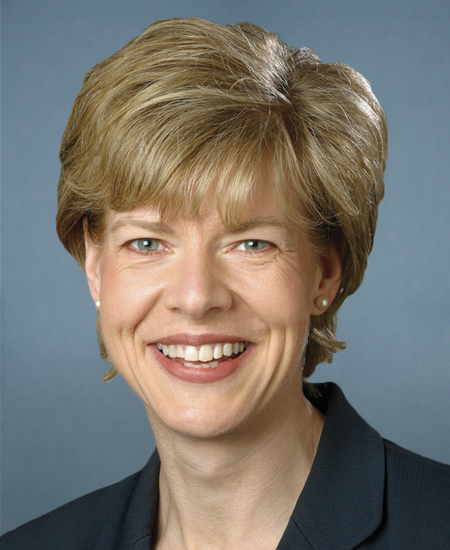
Baldwin Leads 26 Colleagues in Rejecting the Trump Admin’s Latest Move to Politicize and Undermine Education Funding
WASHINGTON, D.C. – Today, U.S. Senator Tammy Baldwin (D-WI), Ranking Member of the Senate Appropriations Labor, Health and Human Services, and Education Subcommittee, led 26 of her Senate colleagues in slamming the Department of Education’s (ED) latest move to further undermine the Department and jeopardize billions of dollars in funding for schools. Specifically, the Senators outlined their concerns with ED’s proposed changes to the Education Department General Administrative Regulations (EDGAR) that would allow the President’s political appointees to cancel grants to local schools for any reason – putting everything from school-based mental health programs to teacher training programs under constant threat of being defunded at any point. The Senators also raise concerns that, if implemented, the rule would lead to weaker evidence-based standards for programs that serve students, hinder student achievement, and defy Congressional intent. This rule comes on top of a tumultuous funding process under the Trump Administration, which has continued to try to entirely shut down the Department of Education. “This proposed rule is unnecessarily broad and vague, would undermine the stability of educational programs, and does nothing to improve educational outcomes for students,” wrote Baldwin and the Senators in a letter to Secretary McMahon. “As the Trump Administration continues its illegal attempt to dismantle the Department, this proposed rule will only serve to increase chaos and uncertainty for schools, states, institutions of higher education and families across the Country.” Specifically, the Trump administration’s proposed rule allows the department to terminate a grant “for convenience.” This would allow Trump’s political appointees to terminate grants, even ones that have been awarded, with no justification. “Schools and other grant recipients need a meaningful degree of certainty to properly plan their budgets and provide services to students,” the Senators continued. “Broad, unwarranted termination and discontinuation authority makes it difficult, if not impossible, for recipients to responsibly plan and spend these funds. In section 75.253(c), the proposal also would remove a priority to continue previously awarded grants over awarding new grants. These changes will increase funding uncertainty which may discourage recipients from undertaking ambitious projects.” “We know high-quality education has the ability to raise families out of poverty and meaningfully improve future earnings. However, at a time when student achievement is falling and families are struggling with rising costs, this proposed rule only serves to undermine efforts to improve outcomes for students and raise costs by creating financial uncertainty for schools and educational programs,” Baldwin and the Senators concluded. “This damage and uncertainty will only hurt student populations that federal funding intended to support.” Senator Baldwin has been an outspoken critic of President Trump’s stated goal of dismantling the Department of Education and continued efforts to withhold funding from American students and schools, including blocking $7 billion in Congressionally approved funding ahead of the 2025-2026 school year. Last December, Baldwin led a group of her colleagues in calling out the Trump administration’s moves to illegally outsource core functions of the agency that students and their families rely on. In April, Baldwin pushed Sec. McMahon on Trump’s budget that cuts $6 billion from K-12 schools, including $105 million for Wisconsin’s public schools. The letter was also co-led by Senators Patty Murray (D-WA), Jeff Merkley (D-OR) and signed by Senators Charles Schumer (D-NY), Richard Durbin (D-IL), Chris Van Hollen (D-MD), Mazie Hirono (D-HI), Edward Markey (D-MA), Tim Kaine (D-VA), Brian Schatz (D-HI), Andy Kim (D-NJ), Angela Alsobrooks (D-MD), Tammy Duckworth (D-IL), Jack Reed (D-RI), Richard Blumenthal (D-CT), Michael Bennet (D-CO), Lisa Blunt Rochester (D-DE), Adam Schiff (D-CA), Ron Wyden (D-OR), Kirsten Gillibrand (D-NY) Bernard Sanders (I-VT), Elizabeth Warren (D-MA), Alex Padilla (D-CA), Ruben Gallego (D-AZ), Christopher Coons (D-DE), Sheldon Whitehouse (D-RI), and Mark Kelly (D-AZ). Full text of the letter is available here and below. Dear Secretary McMahon, We write in opposition to the proposed rule, “Education Department General Administrative Regulations” (EDGAR) (Docket ID ED-2026-OPEPD-2542),1 which would make fundamental changes to the administration of formula and competitive grants Congress has authorized and funded through the U.S. Department of Education (“the Department”). This proposed rule is unnecessarily broad and vague, would undermine the stability of educational programs, and does nothing to improve educational outcomes for students. As the Trump Administration continues its illegal attempt to dismantle the Department, this proposed rule will only serve to increase chaos and uncertainty for schools, states, institutions of higher education and families across the country. One of the key functions of the Department is to award and administer both formula and competitive grants. These grants range from Title I-A, which provide additional funding for elementary and secondary education programs serving students from low-income communities, to TRIO grants providing support to first generation college students, to Innovative Approaches to Literacy grants which promote literacy programs in low-income communities, and every education stage in-between. The funding provided to the Department for programs authorized by Congress is essential to ensure schools and communities across the country are able to provide every child, regardless of their zip code, a high-quality education. Political Interference in Grant Awards and Administration The proposed rule (Section 75.901) would give the Department free rein to end already awarded grants “for convenience,” without substantive reason or justification or connection to performance under a grant. Grants provided by the Department frequently support multiyear contracts involving the hiring of staff who provide services to students, research activities, and commitments to students and families that cannot be easily unwound. Schools and other grant recipients need a meaningful degree of certainty to properly plan their budgets and provide services to students. Broad, unwarranted termination and discontinuation authority makes it difficult, if not impossible, for recipients to responsibly plan and spend these funds. In section 75.253(c), the proposal also would remove a priority to continue previously awarded grants over awarding new grants. These changes will increase funding uncertainty which may discourage recipients from undertaking ambitious projects. The proposed indirect-cost provision (section 75.228) will only add to this financial instability and uncertainty. This proposal could create a race to the bottom with an incentive structure where applicants are not encouraged to create programs based on value and merit but instead based on how much institutional costs they can absorb themselves. This will disadvantage entities that are not well-resourced, such as entities in rural communities or on tribal lands. Furthermore, lowering the amount of funds that can be used on indirect costs will not actually lower those costs for programs. Capping the amount of funds will not lower the cost of rent or electricity for an after-school program or a rural college serving first-generation students. Undermining Congressional Intent in Serving Underserved Students and Communities The General Education Provisions Act (GEPA) governs the administration of the Department and its grant programs. Section 427(b) of GEPA requires the Secretary to ensure each applicant for federal education funding describe how the applicant will ensure equitable access and participation to all students and teachers in federally funded education programs including “based on gender, race, color, national origin, disability, and age.”2 This demonstrates a clear Congressional intent that federal education programs help provide assistance to students and communities that have been historically underserved in our nation, including students of color, students with disabilities, English learners, and LGBT students. This proposed rule would further gut the intent of GEPA Sec. 427, which the Department has undermined by not renewing the information collection it previously collected from its applicants for grant programs. Section 75.210(d) of the proposal weakens compliance by removing the current EDGAR requirement for the Secretary to consider equitable and adequate access on the basis of economic disadvantage, gender, race, ethnicity, color, national origin, disability, age, language, migration, living in a rural location, experiencing homelessness or housing insecurity, involvement in the justice system, pregnancy, parenting or caregiver status, and sexual orientation. In addition to section 427 of GEPA, many federal laws3 authorized on a bipartisan basis direct federal education programs to focus on many of these underserved student populations. Removing this provision from EDGAR goes against Congressional intent not only in GEPA, but in these core foundational education laws. This Proposed Rule Will Lead to a Weaker Evidence Base for Education Programs The proposed rule also suggests a number of changes that would weaken evidence standards that govern Department programs. In changes detailed in section 77.1(c), the proposed rule would permit unknown, non-governmental organizations to determine whether grantees’ strategies and interventions meet the different levels of evidence established in EDGAR. This would break from how evidence standards are determined now by IES through a transparent and rigorous process. This could result in these important evidence standards being applied inconsistently within grant competitions. The evidence standards established in federal legislation and implementing regulations are critical to ensuring limited federal funds are spent on meaningful interventions that improve student outcomes. We are concerned that such goals are undermined by having unknown third parties judge applicants’ grant applications for whether or not they meet such evidence standards without a clear, rigorous, consistent, and transparent evaluation process. We know high-quality education has the ability to raise families out of poverty and meaningfully improve future earnings. However, at a time when student achievement is falling and families are struggling with rising costs, this proposed rule only serves to undermine efforts to improve outcomes for students and raise costs by creating financial uncertainty for schools and educational programs. This damage and uncertainty will only hurt student populations that federal funding intended to support. We urge you to withdraw the proposed rule. Sincerely,
30d30e43-8204-4dd7-b9f7-c374fb889cf2Issued within 24 hours
Other senators' releases published in the day before or after this one.