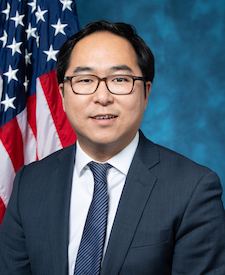
Senator Kim Introduces Series of Legislation to Root Out Corruption in Government
The three bills build on Senator Kim’s anti-corruption agenda to restore trust and integrity in government and fix America’s broken politics WASHINGTON, D.C. – Today, Senator Andy Kim (D-N.J.) introduced three new bills to tackle public corruption and empower individuals to hold government officials accountable for betraying the public’s trust. “Americans look at their government and think, ‘corruption.’ They’ve lost trust that their public officials are looking out for them first, instead of themselves. It’s a threat to our democracy and our responsibility to fix,” said Senator Kim. “It isn’t enough to call out each corrupt act of the Trump administration. We need to dig deeper and move true legislative solutions forward that take on corruption no matter your party, position, or how wealthy you are. Enough is enough.” All three bills are co-sponsored by Senator Cory Booker (D-N.J.). Anti-Bribery Improvement Act (aka “the McDonnell Fix”) In 2016, the Supreme Court ruled in McDonnell v. United States to narrow federal bribery law and the definition of “official act,” making it harder to prosecute public officials who accept loans, gifts, or anything of value from individuals seeking an action from the public official in return. For example, their ruling would allow a public official to accept $175,000 in loans and gifts from an individual seeking government approval of a nutritional supplement. Senator Kim’s Anti-Bribery Improvement Act expands the current definition of bribery to include buying or selling access to a federal official by: Expanding the federal bribery statute to explicitly criminalize corrupt access to public officials by defining “access” to mean “use of a public official’s ability to influence any decision or action on any question or matter, which may at any time be pending, or which may by law be brought before such public official, in such official’s official capacity, or in such official’s place of trust or profit.”; and Addressing the Supreme Court’s concern about criminalizing routine legislative work by requiring a showing of an express agreement to exchange access for the thing of value. No Gratuities for Governing Act (aka “the Snyder Fix”) In 2024, the Supreme Court’s ruling in Snyder v. United States all but permitted government officials to accept gratuities, which are “typically payments made to an official after an official act as a token of appreciation.” Notably, their ruling pointed out that federal corruption law prohibits bribes, which is defined as payments made before the official act. For example, their ruling allows a public official to ask for and accept $13,000 from a local company after the company has just been awarded a public contract worth $1 million, but if the $13,000 was given before the contract was awarded then it would be corruption. Senator Kim’s No Gratuities for Governing Act would prevent corrupt use of gratuities and make it easier to prosecute the solicitation and acceptance of these “tips” by: Establishing a gratuity threshold of $1,000 or more for any official act by a state, local, or tribal official involved in government business or contracts valued at $5,000 or more; Imposing sentencing of up to two years in line with federal officials who accept gratuities; and Aligning the maximum sentence for state, local, or tribal officials convicted of bribery to 15 years from 10 in line with the maximum sentence for federal officials. This bill is the Senate companion to Representative Dan Goldman’s H.R.4175 No Gratuities for Governing Act. Honest Services Fraud Improvement Act (aka “Private Right of Action”) To combat corruption, prosecutors have often relied on the federal statutory provisions that criminalize “a scheme or artifice to deprive another of the intangible right of honest services” through “wire, radio, or television communication.” However, over the years, the courts have narrowed the scope of the provision based on concerns that the statute is vague, ultimately limiting its application to mail and wire fraud cases where bribes or kickbacks are involved, and thus eliminating the statute’s use for general self-dealing and conflicts of interest. Senator Kim’s Honest Services Fraud Improvement Act would create a private right of action to empower individuals to hold their public officials accountable and allow them to sue public officials for honest services fraud. Specifically, this bill would: Hold liable any local, state, and federal government officials engaged in quid pro quo bribery when the U.S. Department of Justice foregoes prosecuting. Where the government is pursuing a separate criminal enforcement action, allow DOJ to intervene ex parte and under seal in place of the individual. Just as with private rights of action under the False Claims Act, an individual who brings a claim under this bill is entitled to a share of the damages, with any punitive damages going into DOJ’s Asset Forfeiture Fund. ###
57befb32-558b-4091-9d4a-796472099014Issued within 24 hours
Other senators' releases published in the day before or after this one.