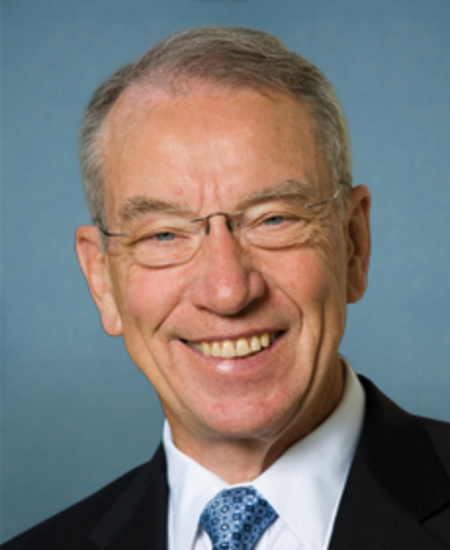
Grassley Outlines Alarming Obamacare Fraud, Unveils Bill Requiring Improved Fraud Risk Assessments
WASHINGTON –Sen. Chuck Grassley (R-Iowa), a senior member and former chairman of the Senate Finance Committee, is shining a light on widespread abuse in the Obamacare program and proposing legislation to stop fraud in its tracks. Grassley’sFraud Risk Assessment of Obamacare Subsidies Accountability Actwould require the Centers for Medicare and Medicare Services (CMS) to improve its fraud risk assessment of Obamacare and issue annual updates to Congress and the Department of Health and Human Services Inspector General.
Full text of the legislation can be foundHEREand a one-page summary can be foundHERE.
Video and a transcript of Grassley’s floor remarks follow.
VIDEO
When theAffordable Care Actbecame law, President Obamapromisedaffordable health care. So, contrary to Obama’s promises, in reality, Obamacare has spiked health insurancepremiumsand led to highercosts.
Instead of fixing Obamacare and lowering costs, Democrats established a new, temporary COVID subsidy for wealthy households. Temporary. That temporary ends December 31. Democrats want to extend it way beyond that. Another example of a temporary program never being very temporary.
So, this temporary subsidy has driven more taxpayer dollars into broken systems wherepremiums keep going upand more money is shoved to insurance companies. Now remember the promises of 2010, Obamacare’s passage that year. It was promised to bring down health care costs by $2,500 and we see now, 15 years later, it’s up at least $5,000. So you can see the promise of 2010 by President Obama was off by $7,500.
So, I want to explain how we got here, discuss my concerns about fraud, waste and abuse in Obamacare; and provide some commonsense solutions to bring down health care costs.
When Obamacare became law, it established taxpayer-funded subsidies through the Federal Health Insurance Marketplace to reduce a household’s monthly insurance premiums. However, these subsidies go directly to insurance companies, not to the consumer.
In the United States today, the median household income is $84,000a year. Permanent law gives Obamacare premium subsidies to a family of three making up to four times the federal poverty line, which is about $106,000a year.
That means someone making $20,000 more than the median household income is eligible for a subsidy under permanent law.
I assume the Obamacare authors probably figured households making much more than the median household income made enough money to buy insurance without taxpayers subsidizing it.
Nothing in this debate takes away middle-income households’ subsidies. A family making up to $106,000 is at 400% of the poverty line. Let me make it very clear. Those families are eligible for a subsidy today, next year, the year after and so on until the law is changed, and I don’t expect it’ll be changed.
Now, in 2021, things changed. [It was] supposed to be temporary, as I pointed out. Temporary laws in this country soon become permanent. In 2021, the Democrats passed their partisan reconciliation law that temporarily lifted the income cap on Obamacare subsidies. Now, that was supposed to temporary.
The cap, which was at four times the poverty line, was removed temporarily in the name of COVID. In other words, the country was facing a very dramatic health issue, and the federal government shut down the economy.
Twenty-two million people were unemployed, and we didn’t really know what it was all about. Now, we learned a lot of lessons from that, and those lessons would not be repeated, hopefully. But this temporary program was set up in this time of great distress about what the future held.
Now, as a result of this temporary program because of Obamacare and COVID, wealthy households making $600,000, which is well above the median household income, are eligible for the temporary taxpayer-funded Obamacare subsidies. Or better known as COVID bonuses.
The expansion of Obamacare subsidies for wealthy earners hascost billions, and the Congressional Budget Office’s (CBO) projections for its costskeepgoingup.
So, in 2021, anticipating some of these problems, I wrote aletterto then-Health and Human Services (HHS) Secretary and also the IRS Commissioner.
In that letter, I expressed concern about the lack of fiscal responsibility in the Obamacare subsidy expansion and how that expansion would lead to more waste, fraud and abuse.
At the time, the HHS Secretaryresponded, saying, “HHS and the IRS take program integrity seriously.”
The HHS Secretary outlined all the ways that the agency was preventing fraud, waste and abuse. I can only conclude that the Biden administration’s response was just empty rhetoric.
Since my letter to the HHS Secretary, the Government Accountability Office (GAO) hasfoundongoing fraud risks in these Obamacare subsidies.
In the last two years, GAO successfullyenrolled 96 percentof its fictitious applicants in Obamacare. I really mean fictitious people. This was a test by GAO to see how easy it was to fraud. Now when they started out, they didn’t know that that might be the result. But I’m going to tell you that that is the result.
For example, the GAO succeeded in enrolling these fake people despite rules requiring documentation to confirm citizenship status and income.
The GAO also found that HHS had let Social Security Numbers be misused by allowing the same number to be used more than once.
The agency also failed to match enrollment data with Social Security’s death data and chose not to reconcile the tax credit overpayments with IRS tax data.
Fraud, waste and abuse doesn’t stop with those examples. This summer, theTrump administrationfound1.6 million people were dually enrolled in 2024 in Medicaid and Obamacare, leading to billions of waste. Now, understand, 1.6 million people having two sources of health care. And then at the same time, we keep telling the public how many people in this country, the millions that don’t have any insurance at all, and here we had 1.6 million people that were enrolled in two health care systems.
My own oversight has shown how:
Extending the COVID bonus permanently increases the deficit by$350 billionand lets billions more go to fraud, waste and abuse.
CBO has found that3.9 million Americanswould lose their employer-sponsored health insurance if we make these subsidies for wealthy earners permanent.
In other words, because of a government program that was supposed to be temporary, and if it’s continued, employers are smart enough to stop their health insurance program and turn it over to the government. And the government subsidy that goes with it.
My colleagues on the other side of the aisle will suggest that they’re only asking for another “temporary” extension of the COVID bonuses for wealthy households. Yet their bill will cost taxpayersnearly $300 billion, and there are no reforms to stop the fraud, waste and abuse.
Now, despitewarningsfrom GAO, the Centers for Medicare and Medicaid Services (CMS) last issued a comprehensive fraud risk assessment of Obamacare subsidies in 2018. Now, the law doesn’t require that report every year, but the GAO said it ought to be issued every year.
And so, by not issuing that on a regular basis, [with] the agency failing to update its fraud risk assessment plan, [it] doesn’t surprise me that we have a lot of fraud. Myoversight in 2013found the Obama administration at the time tried to exempt Obamacare from certain federal anti-trust [fraud] provisions. Yes, the administration, at that time, wanted anti-fraud provisions to be ignored. So, any wonder why you have an environment for fraud.
The full arsenal of civil and criminal anti-fraud protections must be used.
I’ve introduced theFraud Risk Assessment of Obamacare Subsidies Accountability Act. My bill simply requires the agency to update its fraud risk assessment of Obamacare and update it yearly.
I’m glad the agency is alreadyworking to updateits fraud risk assessment, but we must hold the agency accountable to complete this.
I’m glad the Republican-ledCongressand theTrump administrationhave beguncracking downon Obamacare fraud, waste and abuse, thanks to theOne Big Beautiful Bill Actthat the president signed on July 4th.
The new law stops resources from going to illegal immigrants and those not here permanently, establishes improved pre-enrollment verification and requires excess subsidies to be repaid.
It’s a start, but more work needs to be done.
We can lower health care costs and increase quality. It starts with expanding access and competition to high-quality, affordable health insurance through health savings accounts, association health plans and other consumer-driven health plans.
Lowering health care costs requires action to reduce prescription drug prices through pharmacy benefit managers (PBM) and reforming that program.
I’ve been leading the charge tohold PBMs accountableand put sunshine on their opaque business practices.
We also need price transparency. I’m a cosponsor of a bill that’s entitledPatients Deserve Price Tags Actand supported theTrump administration’s effortstoestablish price transparencyon hospitals and health insurance companies through regulations.
Just like all of my colleagues on this side of the aisle, I’m committed to finding solutions to bring down health care costs for American families and not extending government handouts to insurance companies.
-30-
98ba6290-130b-48ee-99b0-b3a065ee197aIssued within 24 hours
Other senators' releases published in the day before or after this one.