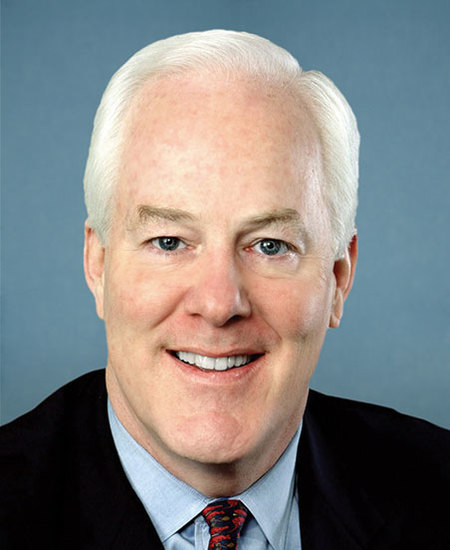
Cornyn Applauds NSF’s $30 Million Investment in UT Austin to Drive Robotics Innovation
Cornyn Applauds NSF’s $30 Million Investment in UT Austin to Drive Robotics Innovation News Cornyn Applauds NSF’s $30 Million Investment in UT Austin to Drive Robotics Innovation August 27, 2026 WASHINGTON – U.S. Senator John Cornyn (R-TX) released the following statement praising the U.S. National Science Foundation’s (NSF) announcement of a $30,000,000 award over five years to The University of Texas at Austin to support a Science and Technology Center (STC), which will accelerate research and development of robotic technologies that can adapt to changing environments and people: “ The National Science Foundation’s investment in UT Austin will fund cutting-edge research to develop robots that are more trustworthy, intuitive, and responsive to the people they serve, ” said Sen. Cornyn. “ NSF has made a smart, strategic decision in choosing the Forty Acres as home for this facility, and I have no doubt that the work starting here will open new frontiers in science and technology that change the world. ” Background : The U.S. National Science Foundation’s (NSF) award was made possible through the Commerce, Justice, Science; Energy and Water Development; and Interior and Environment Appropriations Act, which Sen. Cornyn voted for . The Science and Technology Center at The University of Texas at Austin is one of three new facilities across the country that NSF will support as part of their effort to advance American leadership in science and technology, strengthen the nation’s STEM workforce, and accelerate innovation in fields ranging from artificial intelligence and biotechnology to fusion energy and robotics. The Center for Human and Robot Co-Adaptation at UT Austin will study how people and robots can securely and effectively adapt to one another as service and assistive robots become more common in homes, hospitals, workplaces, and public spaces. Researchers will combine robotics, AI, and human factors to develop new methods that help robots with embodied intelligence learn from people, understand their needs and preferences, and in turn, adapt physically and cognitively to changing environments and different people. The center aims to advance secure, useful robotic technologies that can support independent living, healthcare, and other human-centered services.
cc097505-14d7-46bc-b644-348f79ab95e1Issued within 24 hours
Other senators' releases published in the day before or after this one.