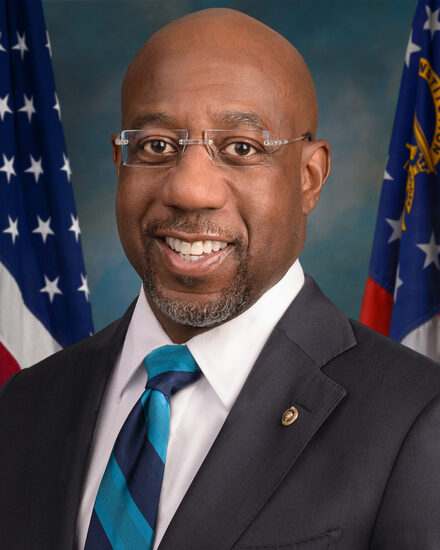
Warnock Centers Investments in Future Generations in Aspen Institute Speech
Today, Senator Reverend Warnock delivered remarks at the Aspen Forum on Children and Families, hosted by the Aspen Institute
Senator Warnock highlighted that the well-being of all children is deeply tied to our collective success as Americans
Senator Reverend Warnock:“I stand here as an example and embodiment of that very idea, the belief that we can build a future where each generation does a little bit better than their parents”
Washington, D.C.– Today, U.S. Senator Reverend Raphael Warnock (D-GA) delivered remarks at the Aspen Institute’s Forum on Children and Families. The Senator highlighted the that the well-being of all children is deeply tied to our collective success as Americans, urging representatives to dream big and create a future worthy of our children.
During his remarks, Senator Warnock reflected on his own journey, which was possible due to federal programs like Pell Grants, Head Start, and low-interest student loans.
“I stand here as an example and embodiment of that very idea, the belief that we can build a future where each generation does a little bit better than their parents,”said Senator Warnock.
“Every single day, when I think about the blessings that have attended my life, I’m fighting for that kid or a world where your parents’ income doesn’t determine your outcome, because God raises up genius and talent all over the world, and they’re Cape streets from Atlanta to Appalachia, Cape streets all around us,”Senator Warnock continued.
Senator Warnock also discussed the spiritual and moral crisis in America, advocating a shift from viewing your neighbors as competitors to a belief that success for one is success for all. He argues that America does not have a lack of resources but a shortage of moral imagination.
“This idea that we’re in competition with each other for scarce resources, that’s part of the trip. This idea where we operate in the narrowest realm of the possible. What can get 60 votes? What can get past corporate special interests and lobbyists? What won’t hurt us in the very next election? It’s a poverty of moral imagination, and everyday Americans can sniff it out,”Senator Warnock concluded.
A transcript of Senator Warnock’s remarks can be viewed below:
“It’s great to be back here at the Aspen Institute as part of this Forum on Children and Families.
I’m especially honored to see members of my class and cohort from Ascend, the greatest class among the folks. Give them a great big round of applause. Don’t pretend to be shy, stand up!
This forum, of course, is inspired by the very American ideal that our country succeeds when our children succeed. Indeed, I stand here as an example and embodiment of that very idea, the belief that we can build a future where each generation does a little bit better than their parents, all of us who are parents, that certainly is our prayer, grandparents, that is your hope, and I have lived that dream yet, I and all of us are living through a time when we feel that dream slipping away.
We all feel it, people on the left and on the right, Democrats, Republicans and Independents. We may not agree on how to fix it, but we all feel it, and the stakes could not be higher, because at root, is a question about whether we can build a future that is worthy of our children.
I’ve been reflecting these days on the Gospel passage in the book of Isaiah where the prophet says ‘the wolf shall live with the lamb, the leopard shall lie down with the kid, the calf and the lion and the fatling together, and the little child shall lead them.’ Even as a preacher, even as a kid who grew up in Sunday school, son of a pastor or two pastors, I often thought that that passage was a little bit too ideally.
What do you mean? The Lion and the Lamb will lie next to each other, will live and a little child shall lead them. I think what the Prophet is saying to us is that here’s the thing that even adversaries have in common, with very, very few exceptions, we love our children. That’s what adversaries have in common. We all love our children.
The Prophet is challenging us to look into the eyes of other people’s children and see our own and know that Dr. King was right, that we’re tied in a single garment of destiny, that the only way for my children, whose father is a United States Senator, in a real sense, the only way for Chloé and Caleb to be okay is for other people’s children to be okay.
And that’s what guides my work every single day in the Senate, and in the church, and in the public square, and it’s the thesis that I hope would guide our conversations here and in other spaces.
We may not always agree on the policy prescription, but if we could start with that basic idea, which is itself fraught in American life today, that other people’s children and their destiny is connected to your own.
I always try to center children because there’s a kid that I’m always fighting for. Long before I was the pastor of Ebenezer Baptist Church, long before the people of Georgia sent me to be their voice in the halls of power, I was a kid growing up in the housing projects of Savannah, Georgia.
I grew up on Cape Street, number 11 of 12 children. Clearly my folks, who are Pentecost, the preachers read the scriptures: Be fruitful and multiply. There’s not much money in my house, but there was plenty of love and plenty of laughter, and I learned the lessons, like the importance of hard work, and my family and my community convinced me that a kid growing up on Cape Street could fly, and that’s why I decided to attend Morehouse College.
I often say that I went to college on a full faith scholarship. Full Faith scholarship, that means you don’t have enough money for the first semester, but you go on faith.
But I was determined that I was going to Martin Luther King Jr’s alma mater. Dr King captured my imagination from childhood. I’m a post-civil rights generation baby, but his voice summoned and captured my imagination as a kid, I just wanted to go to Dr King’s School.
I didn’t know I would leave the church. God always dreams a dream bigger than a dream we’ve been dreaming for ourselves.
But when I got there, I didn’t have enough money, but through hard work and discipline, I was able to finish, but that’s only half of the truth, it was Pell grants and low interest student loans that gave a kid a chance. Work Study.
I’m also a Head Start baby, a good federal program that provides preschool education for children, and then as a high school student, Upward Bound put me on a college campus so I didn’t have to wonder if I belong there. I was already there.
I am an example of what happens when we invest just a little bit. I know what good federal public policy can do for America’s children. And what keeps me up at night is a recognition that it would be harder now for that kid to make it, than it was back then.
And so, every single day, when I think about the blessings that have attended my life, I’m fighting for that kid or a world where your parents’ income doesn’t determine your outcome, because God raises up genius and talent all over the world, and they’re Cape streets from Atlanta to Appalachia, Cape streets all around us.
Places where there are everyday heroes, like the superheroes of my childhood, Superman and the Cape Crusaders, the ordinary heroes, teachers and janitors and aunts and uncles, everyday heroes all around us in plain view, but there’s a sense in our country right now that there is something broken and in need of repair.
I was in Minneapolis yesterday, and it was hard getting back here, but while I was there, I met faith leaders who serve the Twin Cities communities, and they are horrified, as is the rest of the nation, by the two killings in their backyards.
In the Big Ugly Bill, my colleagues increased funding for ICE by $75 billion, making it the biggest federal law enforcement agency in America, bigger than all of the other federal law enforcement entities combined.
That’s the FBI, DEA, US Marshal Service, Bureau of Prisons, ICE is now larger in funding than all of those entities combined, $10 billion, now $75 billion. With $75 billion, we could have provided universal preschool for every four-year-old in America.
And so, as I often say, our country suffers not from a poverty of resources, but a paucity of moral imagination, a lack of commitment to building a future worthy of our children.
So, when you see those ugly scenes in Minneapolis, see what happened to Alex Pretti, who, in the best of the Civil Rights tradition, laid his body on the line.
If you’re raised like I was raised. You watch that video, and you know that the moment they shoved that woman on the street, his fate was already sealed, because there was no way anybody raised like I was raised is going to stand there and allow that to happen and not try to protect her? His faith was already sealed.
Renee Good could have lived; she could have lived within her privilege. It’s not difficult for her to find safety, but she saw what was happening to her neighbors, and she paid the ultimate price for it.
And then we saw the photo of little Liam Conejo Ramos, a five-year-old kidnapped by the government, used as bait.
You think about what they’ve invested in ICE, I think about it in terms of America’s carceral state. You can’t talk about police brutality without talking about the size of our incarceration system. We warehouse more people in prison than any nation in the world; America does. We warehouse a greater percentage of our people than any nation in the world, even those nations whose human rights regimes we deplore. Nobody even comes close.
And when you build a beast that big, it’s got to eat. You got a big dog; it eats what big dogs eat. It doesn’t eat like small dogs. And so, I fear that we’re going to see this played out all across our country if the people of this country don’t stand up and demand something different.
You’re going to see this all over the country because they built this monstrosity of an operation that they claim was a law enforcement operation. But then I heard the Attorney General say, we’ll leave the city. Just give us your voting records.
I’m just telling you what they said. I’m not being partisan. I’m just reporting the news. That’s what they said.
And so, there’s a sense of trauma in this moment, but if we tell the truth, we’ve been feeling this brokenness for a long time. Across Republican and Democratic administrations. Over the last 50 years, there’s been a growing chasm between how hard folks are working and the lives that they’re able to provide for themselves and their families.
It’s created a drag on the American spirit. The opportunity we were promised that has not actualized. Real wages for working families have been stagnant, and today, the price of everything from health care to housing to energy bills to childcare is becoming more expensive. People are working harder and harder, but seeing less and less from the work they’re putting in.
And young people are wondering if they’ll ever be able to afford a home, and an economy where the average age for buying your first home is 40. Older people are wondering if they’ll ever be able to retire with dignity. And workers are seeing that they’re creating wealth for others, yet they’re barely able to get by. And when you have that kind of increasing disconnect between the promise and the lived reality of everyday people, that is not only a problem for your material well-being, I submit that it creates a gnawing feeling that things are amiss. It is a spiritual problem.
See if I can make that plain. Have you ever awakened in the morning, and you just didn’t feel good? You couldn’t quite put your finger on it. You didn’t necessarily feel terrible, but you just, you said, I don’t feel good. We all have different ways of saying, I don’t feel like myself today. And then you sort of stumble around because you feel this ache of fogginess and the fatigue, and you discover that you have a low-grade fever.
America has a low-grade fever and has been in this place of spiritual weariness a long time now, and this decade’s issues left untreated has brought us to where we are today, a nation in crisis. A nation disconnected from the values that make us who we are at our best, therefore a nation where we no longer see our neighbors as crucial to our own success, but as competitors and a competition for scarce resources.
These deficits in a wealthy nation and on a plentiful planet speak to a spiritual deficit that is At its core, a lapse in the covenant that we have with one another, and so suddenly, using your tax dollars towards programs to help some kid you’ll never meet doesn’t feel like a priority, because you’re struggling to set up your own children’s success.
And if people can’t believe in the promise of opportunity, they may choose to put their faith in people who make false promises and provide targets for their anger and their frustration. It is precisely the kind of context that authoritarians love, because people who have no vision, traffic in division. They don’t know how to lead us, and so they try to divide us.
So, what we saw on the streets of Minneapolis, what we’re seeing all across this country, is just that cynical powers are trying to convince us through the iconography and liturgy and machinery of war, that we are at war with one another. That it’s your neighbor who is the problem.
Yesterday, I saw the folks in Minneapolis up close. They’re standing in the freezing cold because in this case, they’re like, ‘I actually know that person. I know that family.’ Proximity is its own medicine. There’s something that happens if we’d actually find enough courage to get close to the people whom we imagine to be something that we’ve created.
And so, the conclusion that our country is in the midst of a spiritual crisis is not something that I came to lightly. It’s a conclusion that I’ve come to as a pastor who has spent decades counseling people drowning in deep cynicism and despair. I prayed with families in hospitals as they make critical decisions around the care of their loved ones while also worrying, how are they going to pay the bill? As a pastor and a senator, I’ve delivered aid to people who work every day but still can’t pay the rent because housing is unaffordable.
This low-grade fever didn’t just appear. It has been festering for decades across Republican and Democratic administrations. For too long, politicians in both parties have failed to center the people, and the cycle of despair has led us further into the spiritual abyss.
So, part of how we get out of it is we dare to dream big.
This idea that we’re in competition with each other for scarce resources, that’s part of the trick. This idea where we operate in the narrowest realm of the possible. What can get 60 votes? What can get past corporate special interests and lobbyists? What won’t hurt us in the very next election? It’s a poverty of moral imagination, and everyday Americans can sniff it out.
You all know when politicians’ obsession with self-preservation is getting in the way of chasing real solutions, you feel it. So, the cynicism sets in. The American people know that folks in power more focused on themselves than the people who sent them to Washington.
And so today, here at the Aspen Institute forum, we can choose a different path. I would dare us to dream big. All of a sudden, enough money devoted to ICE to provide a universal pre-K is just one example of what I mean. It is an issue of priorities.
So, in closing, and nobody believes a Baptist preacher when he says in closing.
One of the proudest moments I’ve had in this work in the Senate is the day we confirmed Ketanji Brown Jackson to the United States Supreme Court. Regardless of your politics, we all recognize that it was a grand and historic moment, which kind of bearing witness to the American covenant. E pluribus unum. Out of many, one.
So, the chamber was full that day, on both sides of the aisle, and there I was standing, talking to my colleague, Cory Booker, and sitting in the chair was the Vice President Kamala Harris. The three of us standing there talking to each other, with her sitting in the chair. At that time, we were more than a quarter of the Black United States senators who’ve ever served in the history of the Republic, three Black people having a conversation on the floor of the Senate. They’ve now been 14 at the time they’ve been elected.
And as we were sitting there, Vice President said, ‘guys, this is quite a moment.’ I said, ‘yes, it is.’ She said, ‘you know what you ought to do. You ought to write a letter to somebody you’re thinking about in this historic moment’, she made that suggestion, in the way that Black women make suggestions; If you know, you know.
Anyways, then she handed each of us a sheet of paper! But it wasn’t just any sheet of paper, it was the letterhead of the Vice President of the United States. And I actually went back to my office, and I sat down and I wrote a letter, because the only job I love more than being a pastor and a Senator is father to my two little children. And I wrote a letter to my daughter.
I said, Dear Chloe, today we confirm to the United States Supreme Court Ketanji Brown Jackson. In the long history of our country, she’s the first Supreme Court Justice who looks like you, with hair like yours. As we were confirming her, a friend of mine, the Vice President, suggested that I write a letter. In the long history of our republic, she’s the first Vice President who looks like you. I write to you to say that in America, you can become whatever you set your heart and your head to become. Love, Dad.
That was my letter to my own little daughter, who, at the time, was five years old. I was so moved by the moment and its implications for her and kids like her all across our country, red, yellow, brown, Black and white, poor kids everywhere, that I couldn’t mail the letter or wait till I got home. I called her on FaceTime and I read the letter; she listened to the letter.
She was not impressed.
She said, can I go out and play now? She didn’t understand it then. She was just five years old, but she’ll understand it better, as we say in my church, by and by.
As I close, I would say to us at this forum that public policy is a letter that we write to our children. We ought to ask ourselves what we want that letter to say, and a little child shall read it.”
###
e593ab22-d1e2-4bc5-b8bf-2064d2143fd4Issued within 24 hours
Other senators' releases published in the day before or after this one.